NFT Market Trackers in 2026: Which Tools Still Work
We rechecked every NFT tracker from our 2023 list on 5 October 2026, measured a day of Ethereum NFT sales, and tested three queries for building your own tracker.
An NFT market tracker tells you what sold, at what price, who bought it and who holds a collection now. We first published this list in July 2023. On 5 October 2026 we went back to each tool's own site to see what still runs.
Of the nine other tools on that list, two still do the job they did then: OpenSea and CryptoSlam. Four have closed or dropped NFT data, and three changed enough that they no longer track the whole market. We added two floor-price sites that cover many chains.
| Tool | Status on 5 October 2026 | What it offers now |
|---|---|---|
| OpenSea | Running | Ranking with floor, 1-day volume and sale count, owners and supply; API with a key |
| CryptoSlam | Running | Rankings by volume, with buyer and seller counts and top sales, by chain |
| CoinGecko (new) | Running | Floor price, market cap, 24-hour volume and sale count for 1,961 collections |
| NFTPriceFloor (new) | Running | Floor, volume, sales, owners and market cap for 1,799 collections |
| Rarible | Changed | Marketplace and an API for trades, orders and metadata; no market-wide stats page found |
| NonFungible.com | Frozen | History for 44 projects; the data stops in March 2025 |
| LunarCRUSH | Changed | Ranks NFTs by share of social media talk; no prices or volume |
| Nansen | NFT tools closed | NFT analytics shut on 27 May 2025; holdings still show in Nansen Portfolio |
| DappRadar | Shut down | Founders announced the closure on 17 November 2025 |
| Rarity.tools | Gone | The domain sends visitors to the project's X account |
| NFTBank | Pivoted | Now Contxts.ai, which builds models for DeFi and finance |
| Bitquery | Running | Explorer pages and a GraphQL API for NFT trades, transfers and holders |
One day of Ethereum NFT sales
In the 24 hours to 10:42 UTC on 5 October 2026, Bitquery's Ethereum trade data held 12,080 NFT sales across 864 collections, bought by 2,084 wallets. Every sale in that data went through Seaport, the trading contract OpenSea publishes. Over the 30 days to 5 October, Bitquery's archive data held about 394,000 Ethereum NFT sales, and all but 13 went through the Seaport 1.6 contract. None were tagged to Blur. Blur sales that settle through Seaport do show up, sent through Blur's contract, but calls made straight to Blur's own marketplace contracts produced no trade rows. If you need every Blur sale, check coverage before you build on this data.
Sale counts can mislead. A collection called Credits had 4,449 of those sales. Only 326 wallets bought them, about 14 sales each, at prices from 0.0013 to 0.13 ETH, for 34.5 ETH in total. BitMON had 345 sales worth 23.7 ETH. Sorted by count, Credits sits 13 times ahead of BitMON. Sorted by value, Credits and BitMON are close: 34.5 ETH against 23.7 ETH. Before you trust a "top collections" list, check how many wallets bought and what they paid.
The biggest holder is not always a collector. In Bitquery's holder data, the largest holder of Milady Maker is the address Etherscan tags as "Blur: Blend", with 173 tokens. Blend is a lending protocol, and a borrower's token stays locked in Blend's contract as collateral while the loan is open. A holder chart that shows this address as one big owner overstates how concentrated Milady ownership is.
The trackers today
OpenSea
OpenSea's collection ranking shows floor price, 1-day change, top offer, 1-day volume, number sold, owners and supply, over time ranges from one minute to 30 days or all time. Its developer API covers NFTs, listings, offers and token balances on 30 chains, and needs a key.
CryptoSlam
CryptoSlam ranks collections by trading volume over 24 hours, 7 days, 30 days or all time, with counts of buyers, sellers and transactions, the biggest single buys, and a filter by chain. Of the 2023 list, it is the closest to what we described then.
CoinGecko and NFTPriceFloor
Neither was on the 2023 list. CoinGecko's NFT page tracks 1,961 collections on chains including Ethereum, Solana, Bitcoin and Polygon, with floor price, market cap, 24-hour volume and number sold. NFTPriceFloor tracks 1,799 collections with floor, volume, sales, owners, listings and market cap, and offers an API on request. Both counts are from 5 October and move daily.
What closed or changed
- Nansen shut its NFT analytics section on 27 May 2025, citing low usage and the closure of a key data partner. NFT holdings still show in Nansen Portfolio (Nansen changelog).
- DappRadar: its founders announced on 17 November 2025 that they were shutting the platform down because it had become too costly to run (Cointelegraph).
- Rarity.tools no longer loads. The domain sends visitors to the project's X account.
- NFTBank now sends visitors to Contxts.ai, which calls itself the former NFTBank and builds models for DeFi and finance work.
- NonFungible.com still runs its market tracker, but the data for its 44 projects stops in March 2025.
- LunarCRUSH's NFT page ranks collections by their share of social media talk. It shows no prices or trading volume.
- Rarible is still a marketplace, and its API serves trades, orders and metadata. We found no market-wide stats page on it.
Build your own tracker with Bitquery
Bitquery serves Ethereum NFT trades, transfers and holder balances through the same GraphQL API it uses for tokens.
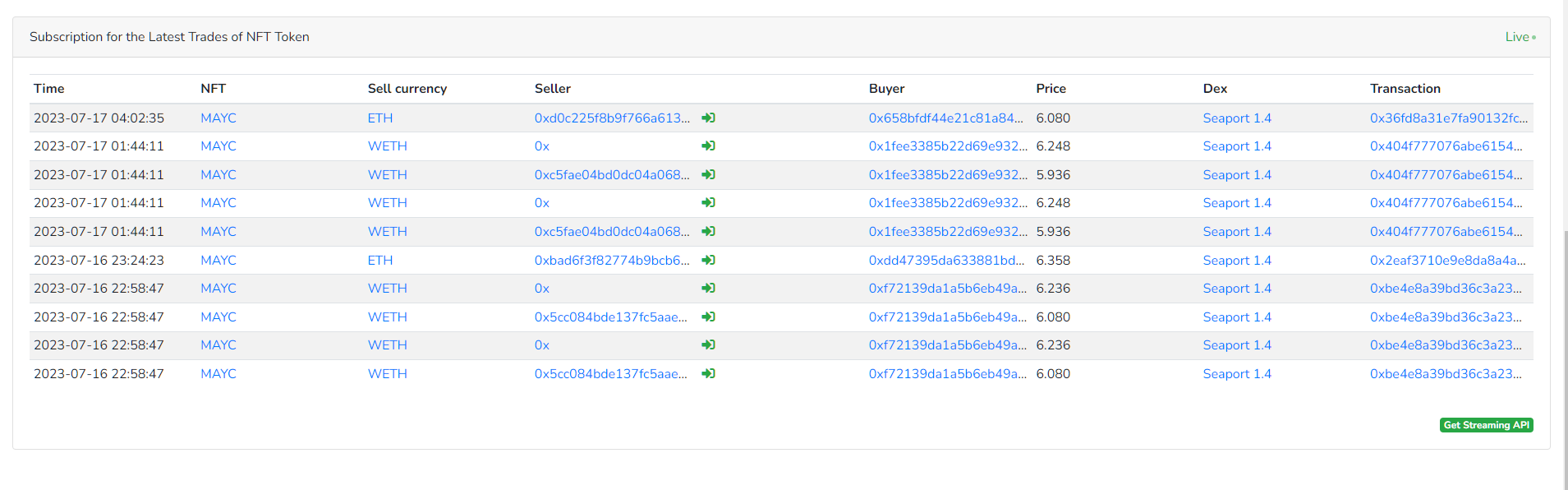
Without code. The Bitquery explorer has a page for each collection, with recent sales, top holders and transfers over a date range you pick. It needs no account. The screenshot shows its live trades widget for Mutant Ape Yacht Club as it looked in July 2023.
With the API. Each query below ran against Bitquery's GraphQL endpoint on 5 October 2026 and returned the results described under it. Paste one into the Bitquery IDE to run it. The NFT API docs list more.
Latest NFT sales on Ethereum
query LatestNftSales {
  EVM(network: eth) {
    DEXTrades(
      limit: {count: 10}
      orderBy: {descending: Block_Time}
      where: {Trade: {Buy: {Currency: {Fungible: false}}}}
    ) {
      Block { Time }
      Trade {
        Dex { ProtocolName }
        Buy {
          Currency { Name SmartContract }
          Ids
          Buyer
          Seller
        }
        Sell {
          Amount
          Currency { Symbol }
        }
      }
      Transaction { Hash }
    }
  }
}
Each row is one token sold: the collection and its contract, the token ID, buyer, seller, the price and what it was paid in, and the transaction. On our run, eight of the ten rows were CLOAKS tokens swept in one transaction at 0.0077 WETH each. We checked that transaction's transfers: Buy.Buyer is the wallet that received the token. One quirk: ProtocolName reads seaport_v1.4 even for trades through the Seaport 1.6 contract (0x0000000000000068f116a894984e2db1123eb395), so filter on the contract address when the version matters.
Top collections over the last 24 hours
query TopNftCollections24h {
  EVM(network: eth) {
    DEXTrades(
      limit: {count: 10}
      orderBy: {descendingByField: "sales"}
      where: {
        Block: {Time: {since_relative: {hours_ago: 24}}}
        Trade: {
          Buy: {Currency: {Fungible: false}}
          Sell: {Currency: {Symbol: {in: ["ETH", "WETH"]}}}
        }
      }
    ) {
      Trade {
        Buy {
          Currency { Name SmartContract }
          lowest_price: Price(minimum: Trade_Buy_Price)
          highest_price: Price(maximum: Trade_Buy_Price)
        }
      }
      sales: count
      buyers: count(distinct: Trade_Buy_Buyer)
      volume_eth: sum(of: Trade_Sell_Amount)
    }
  }
}
This is the query behind the Credits and BitMON figures. It keeps only sales paid in ETH or WETH, so the volume adds like with like. Sort by volume_eth instead of sales to rank by value.
Top holders of a collection
query TopHoldersOfCollection {
  EVM(network: eth) {
    Holders(
      limit: {count: 10}
      orderBy: {descending: Balance_Amount}
      where: {Currency: {SmartContract: {is: "0x5af0d9827e0c53e4799bb226655a1de152a425a5"}}}
    ) {
      Holder { Address }
      Balance { Amount }
    }
  }
}
Swap in any collection's contract. On 5 October the first row was the Blend vault with 173 Milady Maker tokens, and the second row held 52.
How much history. Queries without a dataset argument read the real-time dataset, which on our run reached back to 1 October, about four days of Ethereum NFT trades. On self-service plans, Ethereum trades stay queryable for 30 days, and transfers and balance updates for 4 hours. Complete history, and the Holders data behind the third query, come with the Ethereum archive add-on or on Enterprise.
What Bitquery costs
Bitquery has no free plan. Every paid plan starts with a 7-day free trial: no card, real-time data only, a small quota, and live WebSocket streams included. After the trial:
- Personal: $49 per month, or $29 per month billed yearly. API only, 100,000 API points per month, no streaming.
- Pro: $99 per month, or $69 per month billed yearly. 1 million points, with streaming.
- Scale: $299 per month, or $199 per month billed yearly. 5 million points.
- Enterprise: custom.
Sign up at account.bitquery.io. Full details are on the pricing page.
How to pick a tracker
- To browse what sells, use OpenSea's ranking or CryptoSlam.
- To watch floor prices, use CoinGecko or NFTPriceFloor, which put floor, volume and market cap side by side.
- To get your own numbers, alerts or a dashboard, use an API. You set the filters, and no one else's ranking rules sit between you and the sales.
- Whatever you use, ask what it counts: which marketplaces it reads, whether a ranking is by count or by value, how many wallets sit behind the volume, and whether lending vaults show up as holders.
FAQ
What is an NFT marketplace? A site where people buy and sell NFTs. Each sale settles on chain through the marketplace's contract, which is why a tracker can read it.
Why do two trackers show different volume for the same collection? Each one reads its own set of marketplaces and chains, and prices each sale in its own currency. Our 24-hour query, for example, counts only Ethereum sales paid in ETH or WETH.
Updated on 5 October 2026 by the Bitquery team: the status of each tracker was checked against its own site, changelog or a news report. The trade and holder figures come from Bitquery queries run that day, and the plans and prices were checked against Bitquery's billing catalogue. Entries for tools that closed or changed were cut or rewritten. We removed the claim of a free developer plan (Bitquery offers a 7-day trial instead), the old point-system wording, a claim of full Blur coverage our queries did not bear out, and two July 2023 explorer screenshots that no longer match the live page. The first version was written by guest author Hamid Akhtar and edited by Divyasshree in July 2023. AI tools helped redraft the text.
Subscribe to our newsletter
Subscribe and never miss any updates related to our APIs, new developments & latest news etc. Our newsletter is sent once a week on Monday.