A7 says it does 2,000 payments a day. Its ruble token did 21.
A week after the US Treasury named it a transnational criminal organization, A7 launched a service that turns USDT into a SWIFT transfer for a 0.3% fee, and dozens of paid X accounts repeated its numbers. The one thing A7 runs that is public is its ruble token, A7A5. We counted every transfer of it on Tron and Ethereum, and every USDT that reached the exchange that used to trade it.
- 21 a day
- 126
- $1.01
- $751,000
- 0
01 · The launchA blocked network, two million views, and a 0.3% fee
On 13 October a Russian company called A7 showed off a new service. It calls the service A7 International. The pitch is simple. A firm with a foreign invoice signs up and uploads it. It sends USDT on Tron. A7 then pays the supplier by bank wire. The supplier gets dollars, euros, yuan or dirhams in a normal bank account and never touches crypto.
The press release, sent from Moscow three days later, puts it this way: "customers transfer USDT to A7, which arranges a bank transfer using the beneficiary information provided on the invoice." When the wire is done, the client gets "a SWIFT message or another confirmation document." The fee is 0.3% for firms and for people. At launch the service "accepts USDT transfers on the TRON network."
The launch did not stay in the press release. A survey of crypto X that we ran that week found dozens of paid posts carrying the same figures. The three largest alone reached more than two million views.
| What the launch material claimed | Figure |
|---|---|
| Businesses served, per the 16 October press release | approximately 15,000 |
| Processed in 2025, per the press release | more than 10 trillion rubles |
| Transactions a day, per A7 and the promoted posts | around 2,000 |
| Countries reached, per A7 | more than 100; posts said 150+ |
| Share of payments handled by AI, per the promoted posts | 50% |
| Fee, per the press release | 0.3% |
| Views on the three largest promoted posts | 1.07M, 475K and 439K |
Petr Fradkov, who chairs Bank PSB, calls the service in the release "a new image of A7". Ilan Shor, the chief of A7, explains how it picks a route: "AI analyzes the sender and beneficiary, jurisdictions, and key risk factors of the transaction."
Both men, and the company, are on the US, EU and UK blocked lists. In August last year the US Treasury called A7 "a Russian firm that provides cross-border settlement platforms used for sanctions evasion", owned by Ilan Shor, whom it calls a "sanctioned Moldovan oligarch", and by PSB, a "sanctioned Russian bank". On 1 October this year, twelve days before the launch, the Treasury "sanctioned the A7 Network as a significant transnational criminal organization", a network led by Shor, whom it calls "a sanctioned and convicted criminal fraudster". The same day FinCEN put out an alert and a draft rule to cut the network's agents off from US banks.
So the question is not whether the service is allowed. It is whether the numbers are real. The company does not publish its wallets, and nobody has labelled them. What it does run in public is a token.
02 · What we can seeA7A5, the ruble on a blockchain
The token is called A7A5 and it is pegged to the Russian ruble. FinCEN's alert says it runs on Tron and Ethereum, was made by the network, is issued by a Kyrgyz company called Old Vector LLC, and is "advertised to be backed by ruble deposits held at PSB". The Treasury's October release calls it "a blocked, ruble-backed token issued by Old Vector LLC".
FinCEN also says what the token is for. It "serves as an internal accounting method for the network", it says, "acting as a mirror system to the international payments made by the network." By FinCEN's count, "more than 180 entities processed A7A5 transactions that totaled at least $179.1 billion dollars" from February last year to June this year.
That is the claim we can test. If the token mirrors the network's payments, then the payments leave a trace in the token. Bitquery indexes every TRC-20 move on Tron and every ERC-20 move on Ethereum. So we pulled every move of the token on both chains, every mint and burn, and every USDT that reached the wallets our label set ties to Grinex, the exchange built to trade it.
| A7A5, lifetime to 19 October 2026 | Tron · Ethereum |
|---|---|
| Contract | TLeVfrdym8RoJreJ23dAGyfJDygRtiWKBZ · 0x6fa0be17e4bea2fcfa22ef89bf8ac9aab0ab0fc9 |
| First transfer | 28 January 2025 · 24 March 2025 |
| Transfers | 307,307 · 113,339 |
| Addresses that have ever received it | 41,274 · 21,025 |
| Holders today | not ranked · 17,569 |
| Minted | 94.6bn · 996M |
| Burned | 5.05bn · 0 |
| Outstanding | 89.5bn · 996M |
| Last mint | 2 September 2025 · 21 August 2025 |
| Value of the Tron supply at $0.0116 per token | about $1.04bn |
The supply has not moved in over a year. Every token that exists today was minted before last September. Whatever the new service is settling, it is not settled by issuing new tokens.
03 · 8 OctoberThe day the token stopped
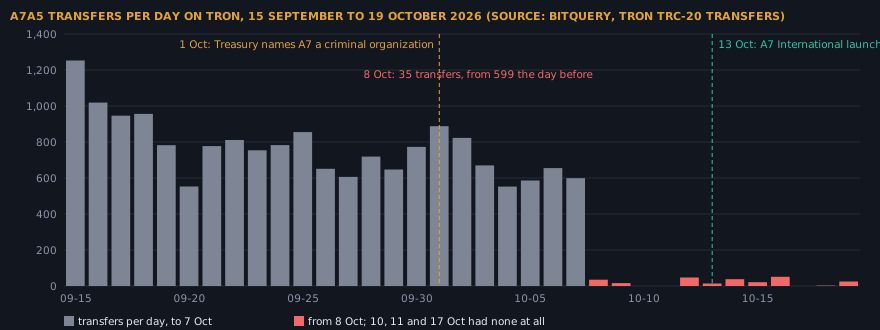
Through the autumn the Tron contract was busy in a steady, small-ticket way. Several hundred moves a day, from a hundred or more wallets, with a median move of about seven thousand rubles. The median is the one in the middle when you line up the day's traffic by size. That pattern held through 7 October. On 8 October it ended.
| A7A5 on Tron | Before 8 Oct · after |
|---|---|
| Window | 29 Sep to 7 Oct · 8 Oct to 19 Oct |
| Transfers | 6,193 · 249 |
| Transfers per day | 688 · 21 |
| Distinct senders | 883 · 62 |
| Distinct receivers | 891 · 66 |
| Median transfer | 7,120 A7A5 ($83) · 64.6M A7A5 ($751,000) |
| Volume | 225.8bn A7A5 · 125.8bn A7A5 |
| Week of 11 October | 171 transfers carried 107bn A7A5 |
Nothing broke. The contract fired no pause or block event in October, no move failed, and Tron itself was clearing well over two million USDT moves a day through the same week. The daily interest call the contract makes, which pays holders the yield the token offers, ran every day until 9 October and then once more on the 19th. The people who used to send a few thousand rubles at a time simply stopped.
What was left is a new kind of traffic. The volume column barely fell, because a handful of wallets kept moving very large sums to each other. In the launch week the token moved more than its whole supply, which means the same tokens went round the cluster more than once.
| Busiest A7A5 wallets on Tron, 8 to 19 October | Sent · received · counterparties |
|---|---|
| TLhXpT4h92GYWFVVkkqJ5p3g5KVTYXxncM | 35.9bn · 35.9bn · 16 out, 14 in |
| TDiUTj2F7744riKE6DhfvHN6dC4xPE3mYw | 30.5bn · 30.5bn · 9 out, 11 in |
| TNnWYcH3Ph4WpH4inLJAfrchN3AoujmtRH | 20.2bn · 19.2bn · 5 out, 3 in |
| TJtXMoWVhmhhhpAfSvKRETRydr1F2TK3TY | 13.0bn · 13.0bn · 2 out, 2 in |
| TBTzstpbNgMVzhTsnFvLnYoCfvT2NaArqS | 3.9bn · 3.9bn · 1 out, 1 in |
| TEt3UzEC4hc2vut4VqsUCUSgKz78e4TyR5 | 3.7bn · 3.7bn · 1 out, 1 in |
| Lifetime flow between the first two | 88bn each way |
Each of these wallets sent out almost exactly what it took in. None of them carries a label in our set or on a sanctions list, so we cannot say who holds them. What we can say is that they trade only with each other, in round billions. That is what FinCEN meant by "moving across internal addresses to maintain a balanced ledger". This is ledger-keeping, and after 8 October it is the only thing the token does.
04 · EthereumThe same cliff, on the same day
On Ethereum the token is a smaller market, about a billion tokens in some 17,000 wallets, but it moved every day. Then it fell off the same cliff on the same date.
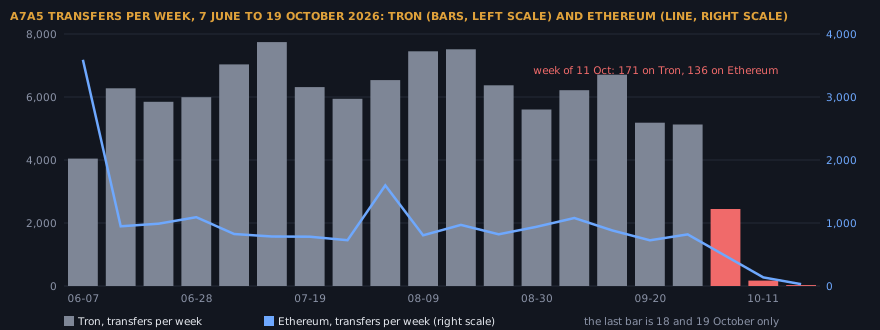
| A7A5 on Ethereum, transfers per day | Count · senders |
|---|---|
| 1 October | 177 · 88 |
| 7 October | 108 · 63 |
| 8 October | 5 · 5 |
| 13 October, launch day | 22 · 13 |
| 16 October | 25 · 6 |
| 18 October | 9 · 7 |
| 8 to 19 October, per day | 16 · 10 |
Two chains with other users, other fees and other wallets do not stop on the same day by chance. Things changed at the network on 8 October, a week after the Treasury listing and five days before the launch. We do not know what. The ledger records what happened, and leaves the reason to the people who did it.
05 · GrinexThe exchange that is not there
If the new service takes USDT from clients, that USDT has to land in some wallet. The obvious place to look is Grinex. The Treasury says Garantex's officers set it up after the March 2025 takedown of Garantex and blocked in August that year. Grinex was where the token traded, and where USDT met rubles.
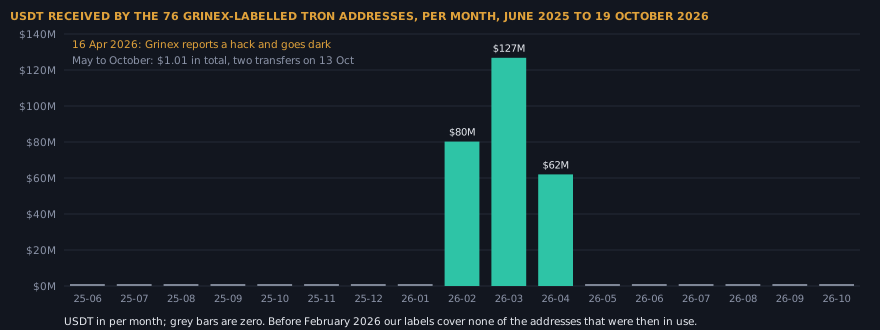
Our label set holds 76 Tron wallets tied to Grinex: hot wallets, exchange wallets, and the wallets on the OFAC, EU and French lists. We counted every USDT that reached any of them.
| USDT into Grinex-labelled Tron wallets | Transfers · senders · USDT |
|---|---|
| February 2026 | 210 · 59 · $80.2M |
| March 2026 | 218 · 78 · $126.8M |
| April 2026 | 74 · 37 · $62.0M |
| May to September 2026 | 0 · 0 · $0 |
| 1 to 19 October 2026 | 2 · 1 · $1.01 |
That matches the public record. Grinex's card top-ups went offline in early April, and in the middle of the month it owned up to a breach it blamed on a nation-state attack, with more than a billion rubles of client money gone. Elliptic's account is that "the only venue with meaningful A7A5 liquidity had failed, taking customer balances with it." FinCEN's alert says that since the hack the token "has been consolidated into unhosted wallets" and that the network is moving away from the blocked exchanges.
So if the new service's USDT is landing anywhere, it is not landing at Grinex. The labelled hot wallets of the exchange the token was built around have been dormant since April. The one dollar on launch day, in two moves from one wallet, is the only USDT the whole cluster has seen in six months.
The issuer is dormant too.
| Old Vector's OFAC-listed Tron wallet | TCFD8N3vM5b4Gr5f1kkajQsodRVNyyAq1d |
|---|---|
| A7A5 received straight from the mint | 45.3bn |
| Passed to TNDjh6WGLYyWmkh8vfu42bXVHUqFNQ3rDq, labelled Grinex | 11.3bn |
| Last outgoing transfer | 23 July 2025 |
| Last incoming transfer | 16 July 2026 |
06 · The claim against the ledgerTwo thousand a day, or twenty-one
The company says it handles around two thousand payments a day. We cannot count the new service's USDT, because we do not know its wallets. We can count the token FinCEN says mirrors the network's payments, and the exchange built to trade it.
| Claim | What the ledger shows |
|---|---|
| Around 2,000 transactions a day | A7A5 on Tron: 21 a day since 8 October; Ethereum: 16 a day |
| Approximately 15,000 businesses | 62 distinct A7A5 senders on Tron in the twelve days to 19 October |
| More than 10 trillion rubles processed in 2025 | FinCEN counted $179.1bn of A7A5 over Feb 2025 to Jun 2026; the token has sat in a handful of wallets since 8 October |
| USDT accepted on Tron at launch | $1.01 reached Grinex-labelled wallets after the launch; A7 International's own wallets are not public |
| Launch on 13 October | 14 A7A5 transfers on Tron that day; none on the 10th, 11th or 17th |
There are two readings. The first is that the service runs on rails we cannot see: new wallets, new banks in the Kyrgyz Republic, and a USDT flow that never touches the token or Grinex. FinCEN's alert allows for that, and so do we. If so, the token that was built as the network's mirror has stopped being one, and the daily payout to holders stopped before the launch was even public.
The second reading is that the numbers in the paid posts belong to the network as it was last year, before Grinex fell and before the October listing. On that reading the service launched into a network that was, by every public measure we have, a fraction of its old size. The posts quoting "2,000+ transactions per day" did not say which year.
Either way, the pattern is the one we keep finding in blocked token networks. The token survives, because a token cannot be switched off, and the life around it drains away. We saw it when we traced dirty money through Tron's biggest exchanges, and when we measured how often stablecoin issuers freeze wallets. This is the clearest case yet. Nobody froze the ruble token. Its users left.
07 · MethodWhat we counted
Every move of the token's contract on Tron, TLeVfrdym8RoJreJ23dAGyfJDygRtiWKBZ, and on Ethereum, 0x6fa0be17e4bea2fcfa22ef89bf8ac9aab0ab0fc9, from the first block to 19 October, with mints and burns read as moves from and to the zero wallet. Daily and weekly counts use moves that went through; none failed in October. Senders and takers are counted once per window, and the median is the exact middle value. Grinex exposure uses the 76 Tron wallets that carry a Grinex label in Bitquery's set, drawn from our own grouping, MetaSleuth, Arkham, OFAC, the EU and France, and counts USDT moves into them by month. Labels on the busiest wallets after 8 October were checked against the same set. The ruble price is Bitquery's A7A5 price on 19 October. Every figure can be re-run with the Bitquery MCP server. The frozen query results, and the audit that ties each printed number to them, sit in the repository next to this article.
We have not identified any wallet belonging to A7 International, and no address in our label directory or on a sanctions list is labelled as one. The USDT that service receives, if any, is not counted here. What is counted is the A7A5 token and the Grinex-labelled addresses, which the Treasury and FinCEN tie to the same network.
Grinex exposure depends on the 76 Tron addresses our label directory ties to the exchange. Grinex may use addresses we have not labelled, so the February to April totals are a floor. Before February 2026 the labelled set received no USDT, which reflects the labels rather than the exchange.
The busiest wallets after 8 October are described by what they did. We do not know who holds them. Their round-number, closed-loop transfers are consistent with FinCEN's description of internal bookkeeping, but we have not confirmed that any of them belongs to A7.
The claims in the first table are A7's own and the promoted posts' own. We quote them as published and make no finding about how many businesses A7 serves off-chain or how many bank transfers it sends. The comparison here is between those claims and the only public record the network leaves.
A dollar value for A7A5 uses one price on one day and is rounded. The token trades thinly and we have not verified its ruble peg.
This article is provided for informational and educational purposes only and reflects analysis of publicly available on-chain data as of the dates indicated. It does not constitute legal, financial, compliance, or investment advice, and nothing in it is a recommendation to buy, sell, or hold any token or asset.
The findings describe token transfers recorded on Tron and Ethereum between January 2025 and 19 October 2026, classified by the rules described in the article. The description of any address as belonging to Grinex, Old Vector or any other entity rests on Bitquery's label directory and public sanctions lists, and may be incomplete or incorrect. Figures may be revised as more data becomes available. Blockchain addresses are pseudonymous.
References to A7, A7 International, A7A5, Old Vector, Grinex, Garantex, Promsvyazbank, Ilan Shor, Petr Fradkov, Elliptic, the US Treasury, FinCEN or any other named company, person or agency describe on-chain activity and public documents, including sanctions designations and press releases, and are not statements about any party's conduct beyond that record. Sanctioned tokens and entities are restricted or prohibited in many jurisdictions, and dealing with them may be unlawful.
Nothing herein should be relied upon as a definitive determination of fact. Readers should conduct their own independent verification before taking any action. The authors and publisher accept no liability for any loss or damage arising from reliance on this material. All trademarks and company names are the property of their respective owners.
Reported by Divyasshree for Bitquery Research, with AI tools; every figure was checked against the raw data.
Check a sanctions claim against the chain
Every TRC-20 and ERC-20 transfer, every label and every sanctions list in this article is queryable in Bitquery. Trace a token, a wallet or an exchange cluster, or ask the MCP server what a network did last week.