Is liquidity leaving exchanges? Binance's stablecoins fell $5 billion since April. It sent $23 billion back to Tether this year.
The claim on X is that stablecoins are draining out of exchanges. We measured it wallet by wallet, and followed the dollars that left to see where they went.
- -$5.0B
- -44%
- $23.1B
- -$7.5B
- $20B
01 · The claimReserves at a one-year low
On 20 October a post on X said that liquidity is leaving crypto exchanges. It came from an account called Wealthmanager. Binance's stablecoin reserves had dropped to a one-year low, it said. Some $6.3 billion had left since April. Other major exchanges showed the same. Less stablecoin liquidity on exchanges means less buying power, the post went on. So the market could struggle until the inflows return.
It was shared widely in a week when the same idea ran everywhere. Spot ETFs were bleeding. Bitcoin had slipped under eighty thousand dollars after a hot inflation print. Everyone wanted to know where the money had gone.
A claim like that can be checked. Exchanges keep their stablecoins in wallets that labeling services have tagged for years: hot wallets that handle deposits and withdrawals, cold wallets that hold the stock. If stablecoins are leaving, those wallets get lighter. If they are not, they do not.
So we did three things. We summed the USDT and USDC in every labeled Binance, OKX and Coinbase wallet on Ethereum at the end of each month for two years. We did the same for USDT on Tron, where most of Binance's retail traffic runs. And we followed the stablecoins that left Binance to the one place they can go to stop being stablecoins: Tether's treasury, where USDT is sent to be redeemed for dollars.
| What we counted | Scope |
|---|---|
| Wallets | Every address tagged as a Binance, OKX or Coinbase hot or cold wallet in Bitquery's address labels: 40 for Binance, 191 for OKX and 193 for Coinbase on Ethereum; 21 for Binance and 31 for OKX on Tron |
| Coins | USDT and USDC on Ethereum, by contract address, so look-alike tokens are excluded. USDT on Tron |
| Balances | The balance of each wallet at the end of each month, October 2024 to 22 October 2026, from Bitquery's balance history |
| Treasury flows | Every USDT transfer between Tether's treasury wallets on Ethereum and Tron and Binance's hot wallets and deposit addresses, January 2025 to 22 October 2026 |
| What we did not count | Stablecoins on other chains, exchange customers' own wallets, and any wallet the labels have not caught. Where a wallet left the labeled set we traced where its coins went |
02 · BinanceFive billion since April, seven since the peak
Binance's labeled wallets on Ethereum tell a clear story. Through last year they filled up. The stock of USDT and USDC tripled in thirteen months, from under $15 billion to $45.6 billion at the November peak, most of it in three cold wallets. Then it turned.
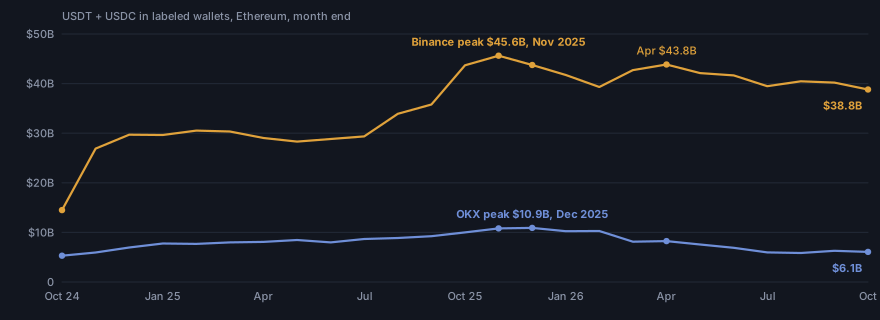
The post's number is close to right and its date is wrong. From the end of April the drop is $5.0 billion. From the peak in November it is $6.8 billion. Either way, Binance's wallets hold a lot less than they did a year ago. And the fall since April is spread over six months rather than a single rush for the exits.
| Binance, labeled Ethereum wallets | USDT + USDC at month end |
|---|---|
| 31 October 2024 | $14.5 billion |
| 30 November 2025, the peak | $45.6 billion |
| 31 December 2025 | $43.8 billion |
| 30 April 2026 | $43.9 billion |
| 31 July 2026 | $39.5 billion |
| 22 October 2026 | $38.8 billion |
Inside the total, the money moved between Binance's own wallets as much as it left. The biggest cold wallet, known as Binance 8, held $28.0 billion of USDT at the peak and holds $16.0 billion now. Two other cold wallets took in $6.2 billion between them over the same months. Hot wallets that held hundreds of millions in November are down to tens of millions. We counted all of them together, so those internal moves cancel out. What does not cancel is the money that left the whole set.
| Binance wallet, Ethereum | USDT at 30 Nov 2025 → 22 Oct 2026 |
|---|---|
| 0xf977814e90da44bfa03b6295a0616a897441acec, Binance 8, cold | $28.0 billion → $16.0 billion |
| 0x47ac0fb4f2d84898e4d9e7b4dab3c24507a6d503, cold | $9.0 billion → $9.2 billion |
| 0x835678a611b28684005a5e2233695fb6cbbb0007, cold | $2.2 billion → $4.8 billion |
| 0x5a52e96bacdabb82fd05763e25335261b270efcb, cold | $0.6 billion → $4.2 billion |
| 0x28c6c06298d514db089934071355e5743bf21d60, Binance 14, hot | $0.3 billion → $0.7 billion |
| 0x56eddb7aa87536c09ccc2793473599fd21a8b17f, hot | $656 million → $65 million |
| 0x9696f59e4d72e237be84ffd425dcad154bf96976, hot | $585 million → $42 million |
03 · OKXThe exchange that really drained
The post named Binance. The sharper fall is at OKX. Its labeled wallets on Ethereum held $10.9 billion of stablecoins at the end of December. They hold $6.1 billion now, a fall of 44% in ten months. Where Binance's line bends, OKX's breaks.
We checked that this was not a labeling trick, where an exchange moves its stock to a fresh cold wallet nobody has tagged yet. Four OKX cold wallets that held $3.7 billion between them in December were run down this year. Three of them emptied into an OKX hot wallet that works as a hub, which forwards to a second hot wallet that pays withdrawals. The fourth feeds that payout wallet directly. Since January the hub has sent USDT to 1.19 million distinct addresses. Two new cold wallets filled up in April, with $0.5 billion between them. That is the only new stock we found, and it is already counted.
| OKX wallet, Ethereum | USDT at 31 Dec 2025 → 22 Oct 2026 |
|---|---|
| 0xb0a27099582833c0cb8c7a0565759ff145113d64, cold | $1.48 billion → $0.56 billion |
| 0xccdcfc4598f539408fc0393b42905c1e0d24a91e, cold | $1.21 billion → 0, emptied in October |
| 0x611f7bf868a6212f871e89f7e44684045ddfb09d, cold | $535 million → 0 |
| 0x6ac38d1b2f0c0c3b9e816342b1ca14d91d5ff60b, cold | $500 million → 0 |
| 0x559432e18b281731c054cd703d4b49872be4ed53, hub | $292 million → $113 million |
| 0xdce83237fbf279c4522e7cac4b10428e2b8694da, cold, new in April | 0 → $383 million |
| Vault wallets holding $500 to $600 million each, nine then eight | $4.8 billion → $4.0 billion |
One thing OKX did not do is send USDT back to Tether. None of its wallets appears among the treasury's counterparties. Its stablecoins went out the front door, to customers withdrawing, and to wherever those customers took them. On Tron its labeled wallets held about $1.2 billion through the whole period, and hot-wallet traffic there has been close to flat.
04 · CoinbaseThe exchange you cannot measure this way
Coinbase is the odd one out, and the reason is worth a section. Its labeled wallets on Ethereum hold about $100 million in stablecoins between them, and have done since the middle of last year. For the largest exchange in the United States, that is a float rather than a reserve.
The answer is Circle. Coinbase co-founded the USDC issuer, and USDC held on Coinbase does not need to sit in a Coinbase wallet. Since March one Coinbase pass-through wallet has received $20.1 billion of USDC from Circle's own wallet and forwarded all of it to the hot wallet known as Coinbase 10, which pays customers. The stock is at the issuer; the exchange draws it down as needed. Twice, in the spring of last year and again this March, more than $4 billion of USDC sat in Coinbase cold wallets for a few weeks and then went back.
So the question "has Coinbase's stablecoin reserve fallen" has no on-chain answer. What we can say is that nothing in its labeled wallets has changed in more than a year, and that the pipe from Circle is open.
05 · TronBinance's other front door
Most retail USDT moves on Tron, and so do most of Binance's deposits. Its labeled Tron wallets held $10.2 billion of USDT two years ago and hold $1.9 billion now. That looks like the biggest exit of all. Most of it is something else.
Binance's Tron cold wallets were emptied in November 2024, with $8.4 billion going to one Binance hot wallet in eleven transfers. That hot wallet then did two things. It sent $3.8 billion to Tether's treasury, and it spread the rest across nine other Binance hot wallets. The same pattern repeated last September and again this spring. Each time, the labeled stock fell, part of it was redeemed and part went to wallets we could not see. From the end of March to now, the labeled Tron stock fell by $2.5 billion.
| Binance on Tron, labeled wallets | USDT |
|---|---|
| 31 October 2024 | $10.2 billion |
| 30 June 2025, the 2025 high | $11.0 billion |
| 31 December 2025 | $1.6 billion |
| 31 March 2026 | $4.4 billion |
| 22 October 2026 | $1.9 billion |
| Cold wallets to one hot wallet, November 2024 | $8.4 billion in 11 transfers |
| That hot wallet to Tether's treasury, November 2024 | $3.8 billion |
| Same route, September 2025 | $3.8 billion |
| Same route, March and April 2026 | $2.0 billion |
Tron tells us less about the stock than Ethereum does, because Binance rotates its cold storage there and the labels lag. It tells us more about the flow. Which brings us to the treasury.
06 · The redemption channelWhere the dollars went
A stablecoin that leaves an exchange wallet has three places to go: a customer's wallet, another exchange, or back to its issuer. Only the last one takes money out of crypto. When a holder redeems USDT, the tokens go to Tether's treasury wallet and are destroyed, and dollars leave Tether's reserves. The treasury wallets on Ethereum and Tron are public, and every transfer into them is a redemption in progress.
Binance is the treasury's biggest exchange counterparty, and this is the year the flow turned one-way. Last year its hot wallets sent $16.6 billion of USDT to the treasury across both chains, while Tether minted $23.1 billion straight into Binance deposit addresses. Binance ended the year $6.4 billion heavier with Tether. This year it has sent $23.1 billion back and received $15.6 billion. It is $7.5 billion lighter.
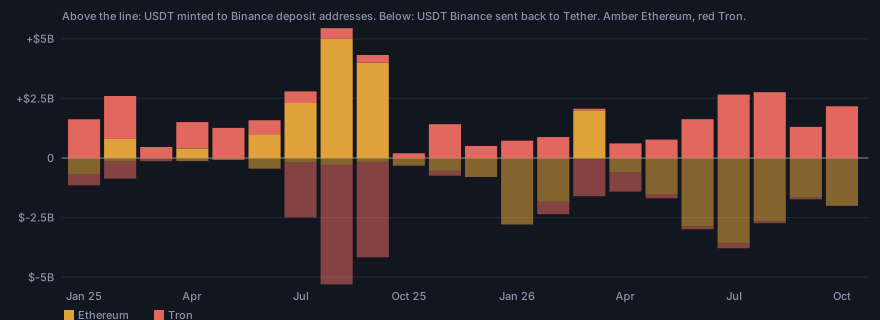
The chains swapped roles too. Last year most of the fresh USDT reached Binance on Ethereum and most of the redemptions left from Tron. This year it is the reverse: Tether mints to Binance on Tron, and Binance redeems from Ethereum. Almost all of it leaves from the hot wallet known as Binance 14, which has sent $18.6 billion to the treasury since the start of last year.
| Binance and Tether's treasury | 2025 / 2026 to 22 Oct |
|---|---|
| Minted to Binance deposit addresses, Ethereum | $13.5 billion / $2.0 billion |
| Minted to Binance deposit addresses, Tron | $9.5 billion / $13.6 billion |
| Redeemed from Binance wallets, Ethereum | $3.8 billion / $19.6 billion |
| Redeemed from Binance wallets, Tron | $12.8 billion / $3.5 billion |
| Net with Tether | +$6.4 billion / -$7.5 billion |
Who else is redeeming? Across both chains, the treasury's other big exchange counterparties are Bitfinex, Tether's sister company, and HTX, which sent $31 billion from Ethereum and received $30 billion on Tron, a chain swap rather than an exit. Upbit redeemed $0.8 billion on Ethereum and received $3.4 billion of mints on Tron. The totals in and out of the treasury are close to balanced this year on both chains, which fits a stablecoin supply that has stopped growing. Binance is the counterparty where the balance tipped.
07 · VerdictMostly true, and not for the reason given
The post said Binance's stablecoin reserves fell $6.3 billion since April. On Ethereum the fall since April is $5.0 billion and the fall from the November peak is $6.8 billion. "One-year low" is right: Binance's labeled wallets last held this little in September of last year. "Other major exchanges show the same" is right for OKX, which fell further, and unknowable for Coinbase.
Where the post goes wrong is the picture of dollars sitting on the sidelines, waiting. A good part of Binance's lost stock went to Tether and was destroyed, rather than to a wallet somewhere else in crypto. Net of mints, $7.5 billion of USDT has left crypto through Binance this year. The buying power did not leave the exchange for the sidelines. It left the stablecoin.
OKX is the other half of the answer. It lost a larger share than Binance, its coins went to customers rather than to the issuer, and nobody wrote a post about it.
08 · MethodHow the numbers were made
Wallets came from Bitquery's address labels: every address tagged as a Binance, OKX or Coinbase hot or cold wallet on Ethereum and Tron, including the ones found by a sweep heuristic, which tags the wallet that deposit addresses sweep into. Balances came from the per-address balance history in Bitquery's Ethereum and Tron data. For each wallet and coin we took the balance on the last day with a change at or before each month end, then summed across the set. Tron balances are kept as changes, so we summed them from each wallet's first day.
USDT and USDC on Ethereum were pinned by contract address, which keeps the hundreds of look-alike tokens out. Treasury flows are every successful USDT transfer between the treasury wallets, 0x5754284f345afc66a98fbb0a0afe71e0f007b949 on Ethereum and TKHuVq1oKVruCGLvqVexFs6dawKv6fQgFs on Tron, and the Binance wallet set, plus the four deposit addresses that the treasury mints into and that sweep to Binance's hot wallets. We read the same mint and redeem pattern in our Tether blacklist audit and in Avalanche's stablecoin supply, where Binance's USDt also went back to the treasury.
The limits are the labels. A cold wallet an exchange has just created is invisible until it is tagged, which is why we traced where emptied wallets sent their coins. Coinbase holds its USDC with Circle, so its wallets show a float and nothing else. And a balance is a stock. It says how much sat in a wallet on a day, and nothing about why.
FAQ
Are exchange stablecoin reserves at a one-year low?
For Binance's labeled wallets on Ethereum, yes. They hold the least since September of last year, $6.8 billion under their November peak. OKX's labeled wallets are down 44% from their December peak.
Did $6.3 billion leave Binance since April?
Close. The labeled Ethereum wallets fell by $5.0 billion between the end of April and now. The viral figure is nearer the fall from the November peak, which is $6.8 billion.
Where did the stablecoins go?
Three places. OKX's went to customers through its withdrawal hub, which paid more than a million addresses this year. Binance's went partly to its own wallets and partly to Tether's treasury, where $23.1 billion of USDT was sent for redemption this year. Coinbase's never sat on-chain in the first place.
Does a redemption mean money left crypto?
Yes. USDT sent to Tether's treasury is destroyed and the holder is paid in dollars from Tether's reserves. It is the one exit that does not land in another wallet.
Why can't Coinbase be measured?
Coinbase holds its USDC with Circle, the issuer it co-founded, and draws it down through a pass-through wallet as customers need it. Its labeled wallets hold about $100 million. The $20 billion that came through the pass-through since March shows the pipe rather than the stock.
How was this measured?
With Bitquery's address labels, per-address balance history and transfer data on Ethereum and Tron. Every figure in the article is re-derived from frozen CSVs by an audit script before publication.
This article is provided for informational and educational purposes only and reflects analysis of publicly available on-chain data as of the dates indicated. It does not constitute legal, financial, compliance, or investment advice, and nothing in it is a recommendation to buy, sell, or hold any token or asset.
The figures describe the USDT and USDC balances of addresses that public labeling sources tag as Binance, OKX or Coinbase hot or cold wallets, at month ends between October 2024 and 22 October 2026, and USDT transfers between those addresses and Tether's treasury wallets. Which wallets belong to an exchange is an inference from those labels and from the sweep patterns described in the method; no exchange has published or confirmed the wallet sets used here, and a wallet the labels miss is not counted. A transfer to Tether's treasury is described as a redemption because that is the treasury's function; the record shows where tokens moved and not the commercial terms behind any transfer.
References to Binance, OKX, Coinbase, Tether, Circle, Bitfinex, HTX, Upbit, Kraken or any other named company describe on-chain records and public statements and are not statements about any company's solvency, conduct or intentions. The post quoted in the opening is reported as it was published by a third party. Stablecoins carry issuer and counterparty risk.
Nothing herein should be relied upon as a definitive determination of fact. Readers should conduct their own independent verification before taking any action. The authors and publisher accept no liability for any loss or damage arising from reliance on this material. All trademarks and company names are the property of their respective owners.
Reported by Divyasshree for Bitquery Research, with AI tools; every figure was checked against the raw data.
Add up any exchange's wallets, on any day
The figures above come from Bitquery's address labels, which tag exchange hot and cold wallets across chains, and from the per-address balance history in its Ethereum and Tron data. The Bitquery MCP is how the wallets were listed, summed and traced.