Crypto gamblers who use more than one casino bring 42% of Ethereum casino deposits. Most of them also play at Stake
Some crypto gamblers keep accounts at several casinos. We followed six months of deposits on Ethereum and Tron to count them, measure what they bring, and see where they go next.
- 42%
- 29%
- $2,114
- 23%
- 3–12%
01 · One casino, or severalMost crypto gamblers stick to one site. A few spread out
Most crypto wallets that send money to a casino only ever use one. A small group spreads its money across two, three or even ten sites. That group is where a lot of the money is.
On Ethereum, wallets that played at two or more sites were about one in seven of all the players we could see, and they brought 42% of the deposits. On Tron they were one in ten and brought 29%.
These players use the big names of crypto gambling. Stake is the largest in our data. Shuffle, Rainbet, Roobet, Duel, Gamdom and 1win offer much the same thing: slots, sports bets and fast payouts in crypto. All of them take money on public blockchains. So the money leaves a trail.
Bitquery indexes every transfer on Ethereum and Tron, so we followed that trail for six months, from April to September 2026, and matched the money going in and out to the wallets of 81 casinos. Then we asked four questions. How many players use more than one casino? How much do they bring? Which casinos share them? And when a player leaves a casino, do they go to a rival? One limit runs through all of it. Players who deposit straight from an exchange account cannot be followed. So every figure here describes players who pay from their own wallet.
02 · The plumbingHow a crypto casino deposit works
Sign up at a crypto casino and it gives you a deposit address, which belongs to your account alone. You send it USDT, a dollar stablecoin, or ETH or TRX. The casino then sweeps that money into its hot wallet, the main wallet it uses to collect deposits and pay out winnings.
That design lets us link accounts. Your deposit address at Stake is different from your deposit address at Shuffle. But you might fund both from the same self-custody wallet, a wallet you control yourself. That wallet then links the two accounts.
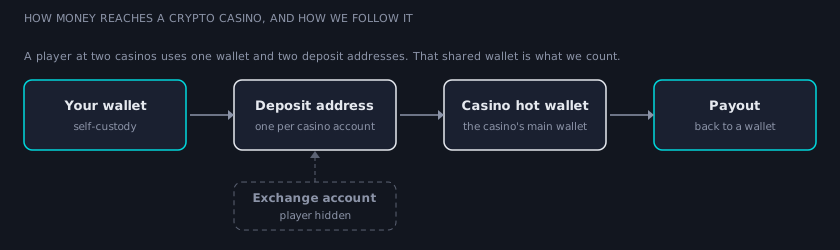
We only count a wallet as a player if it looks like one person. We removed exchange wallets, payment processors, bridges and smart contracts. We also set aside any wallet that moved more than $5 million or dealt with hundreds of other addresses. Casinos that share an owner, such as Stake and Stake.us, count as one.
03 · SizeA small group brings much of the money
Across six months, a few hundred thousand players put money into the casinos we track on each chain. On Ethereum, 15% of them used two or more sites, and that group brought 42% of the deposit dollars. On Tron the split was 11% and 29%.
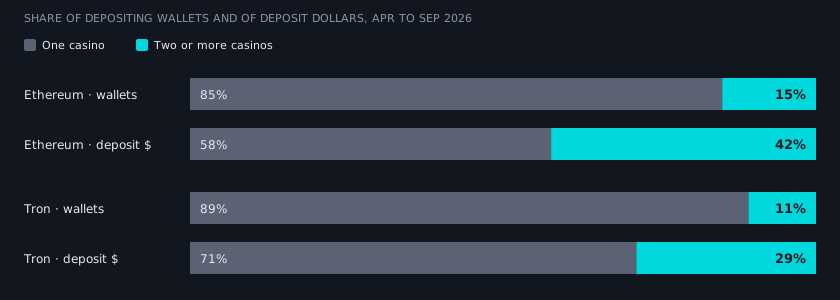
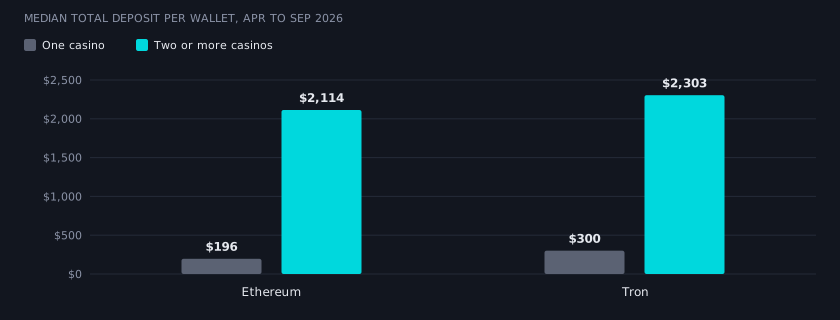
The wallets that spread across sites are also the bigger spenders. On Ethereum, the typical one deposited about ten times as much as a single-casino player. On Tron it was about eight times as much.
| Casinos used | Ethereum players | Ethereum deposits | Tron players | Tron deposits |
|---|---|---|---|---|
| 1 | 223,116 | $1.53B | 213,283 | $1.92B |
| 2 | 26,465 | $539M | 18,327 | $471M |
| 3 | 7,236 | $249M | 4,093 | $159M |
| 4 | 2,691 | $126M | 1,492 | $77M |
| 5 | 1,297 | $83M | 778 | $27M |
| 6 or more | 1,616 | $128M | 1,142 | $40M |
Treat the last row with care. A wallet at six or more sites may be a heavy gambler, but it may also be a small payment service or an affiliate, and we could check only a few hundred of them by hand.
04 · A stress testTiny deposits do not change the picture
Some wallets count as multi-casino because of one tiny deposit at a second site. One wallet we checked by hand had put a few thousand dollars into one casino and $7 into another. So we raised the bar. A site only counted if the wallet had put in at least $20 there, then $100, then $500.
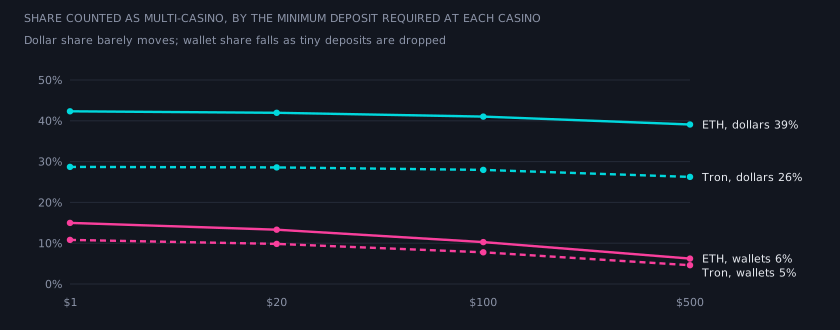
The head count drops fast. At a $500 minimum, only 6% of Ethereum wallets still qualify. The money barely moves. Those players still bring 39% of Ethereum deposits and 26% of Tron deposits. Pick any bar you like. The players who spread across sites still carry a big share of the money.
05 · The overlapStake sits in the middle
When a wallet uses two or more casinos, one of them is usually Stake. That held for 59% of multi-casino wallets on Ethereum and 67% on Tron. Stake also sits in four of the five biggest overlaps on each chain, and the largest pair is Shuffle and Stake. Of Shuffle's Ethereum depositors, 23% also put money into Stake.
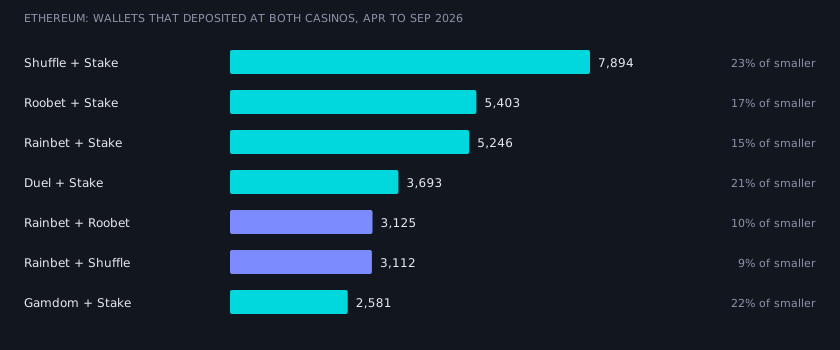
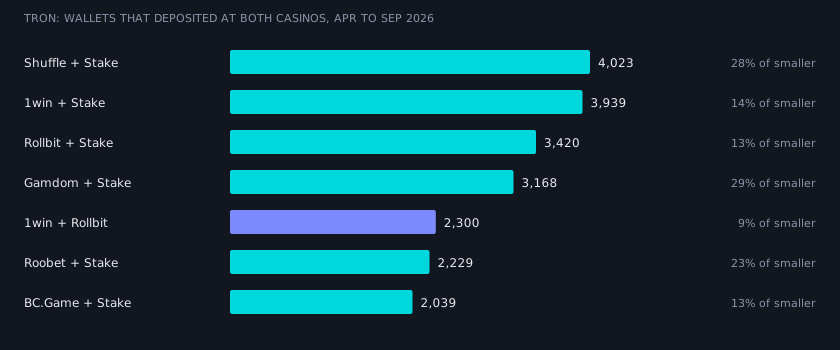
The order matters too. Among wallets that used two of these sites, the most common path on both chains was Stake first, then Shuffle. On Ethereum the reverse, Shuffle then Stake, came next.
| First casino, then | Ethereum players | Tron players |
|---|---|---|
| Stake, then Shuffle | 1,042 | 564 |
| Shuffle, then Stake | 906 | 334 |
| Stake, then Rainbet | 824 | 242 |
| Stake, then Roobet | 636 | 309 |
| Stake, then Gamdom | 287 | 492 |
| Stake, then 1win | n/a | 446 |
The table counts only casinos that took deposits in every month of the window. 1win's Ethereum wallet did not, so that path is left out.
06 · ChurnWallets go quiet, and rarely turn up at a rival
A player who leaves one casino might simply move to another. To test that, we took every wallet that first put money into a casino between April and June, and checked whether it was still depositing there after July.
Most were not. At each of the big casinos in the chart below, 83% to 89% of them had stopped. Very few turned up at a rival. On Ethereum, Stake's leavers moved on least often, under 4% of them.
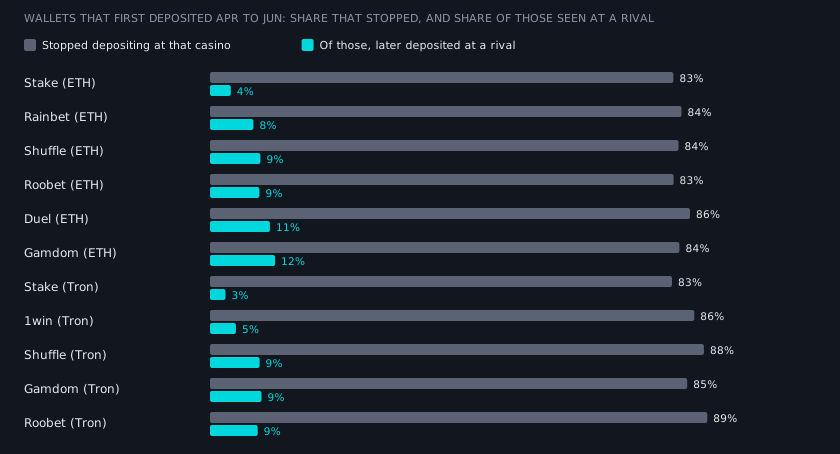
People change wallets. A player who drops one wallet may come back with a fresh one, or start paying in from an exchange, so the low switching rate is a floor. What the data does show is narrower. A player rarely takes the same wallet from one casino to a rival.
07 · The hidden moneyMuch of the casino money never shows a player
The wallets above are only part of the story. On each chain, two other groups sent more money than all the self-custody players combined. One is exchange-scale wallets, which each funded more than 100 deposit addresses in a month. The other is about a thousand very large wallets.
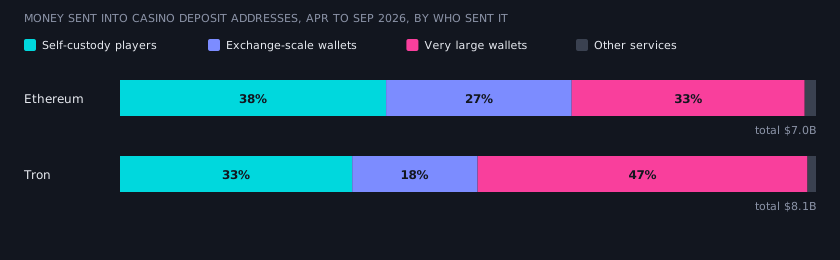
Exchange money is the biggest blind spot. Withdraw from an exchange straight into your casino deposit address and the chain shows only the exchange's wallet. Our labels mark some of those senders as exchange hot wallets. The rest act the same way, and each one feeds more than 100 casino deposit addresses a month.
The very large wallets are a different crowd. Each moved millions. A minority carry exchange labels and most carry none, so they may be whales, agents who pay in for others, or the casinos' own money. We left them out of the player counts. They deserve a study of their own. Our earlier work on exchange money flowing into casinos covers part of that picture.
08 · MethodHow we did it
We started from our labels for the hot wallets of 81 casinos on Ethereum and Tron. We found the deposit addresses that sweep into them, and then whoever funds those deposit addresses. We counted USDT, USDC, ETH and TRX, each transfer worth at least $1, from 1 April to 30 September 2026. The full history behind it is available as files in the Bitquery Data Store, for Ethereum and Tron.
A separate check rebuilt every headline number from the raw data and got the same results, and we traced three random multi-casino players by hand. A quick three-day check on BNB Chain in September found 9% of depositing players at two or more sites. For the casino market as a whole, see our census of on-chain gambling.
FAQ
How many crypto casino players use more than one casino?
About 15% on Ethereum and 11% on Tron. Those are the shares of self-custody wallets that paid into two or more casinos from April to September 2026. The share falls to about 6% and 5% if each site needs at least $500 paid in.
How much money do multi-casino players bring?
They brought 42% of the $2.66B deposited on Ethereum and 29% of the $2.70B deposited on Tron in that period. That share barely moves when small deposits are ignored.
Which crypto casinos share the most players?
Stake sits in four of the five biggest overlaps on both chains. The largest pair is Shuffle and Stake: 23% of Shuffle's Ethereum depositors and 28% of its Tron depositors also deposited at Stake.
Do crypto casino players switch to rival casinos?
Rarely with the same wallet. Most wallets that first paid in during spring, 83% to 89% of them, had stopped at that casino by August. Only 3% to 12% of those later showed up at a rival.
Can you see every crypto casino player on-chain?
No. Players who deposit straight from an exchange account appear only as the exchange's wallet. On Ethereum, money from self-custody players was about 38% of all money sent into casino deposit addresses, and on Tron about 33%.
Follow casino money in plain English
Every wallet and transfer in this story comes from Bitquery's Ethereum and Tron data. The Bitquery MCP server puts that data behind an AI assistant, so you can trace where a casino deposit came from or who funds a site, without writing the query yourself. Developers can start from our Ethereum API and Tron API, and the full history is in the Data Store for Ethereum and Tron.
Window: 1 April to 30 September 2026, from Bitquery's Ethereum and Tron archives. Casinos are identified by Bitquery's labels for their hot wallets (160 addresses on Ethereum, 103 on Tron) as they stood in October 2026. Brands without a labeled hot wallet, and hot wallets that were replaced during the window, are missed. BC.Game's Tron wallets go quiet from 28 July and Rollbit's Tron wallet starts in July.
A deposit address is an address that, within a calendar month, forwarded 80% to 125% of what it received to a casino hot wallet and had no more than 50 funders. Deposits swept in the following month are missed, so some wallets are credited with fewer casinos than they used. Payment processors (AlphaPo, Kirgo, Radom) were removed from the casino list; brands with one owner (Stake and Stake.us; Bitcasino and Sportsbet.io) count as one.
A player wallet has no exchange, processor, bridge or contract label, signs its own transactions, and in the window had fewer than 200 counterparties and under $5 million of turnover. The full check ran on every wallet with $200,000 to $5 million of casino flow; smaller wallets were checked against our main service labels only. Figures are per chain and are never added across chains.
Payouts are not used for the headline. Payout totals include small fee top-ups that casinos send to their own deposit addresses, and many players deposit from exchanges, so a wallet's deposits and payouts cannot show whether it won or lost. The BNB Chain check covers 1 to 3 September 2026, stablecoins only, without the label and size checks.
This article is provided for informational and educational purposes only and reflects analysis of publicly available on-chain data as of the dates indicated. It does not constitute legal, financial, compliance, or investment advice, and nothing in it is a recommendation to gamble or to use any casino or service.
Behavioral labels such as player, multi-casino wallet, exchange-scale wallet and very large wallet depend on the definitions described above and may be incomplete or revised as more data becomes available. Blockchain addresses are pseudonymous, and an address sending or receiving funds does not by itself establish the identity, intent, or knowledge of any party.
References to Stake, Shuffle, Rainbet, Roobet, Duel, Gamdom, 1win, Rollbit, BC.Game or any other named company or project describe what the record shows about addresses and transactions linked to them. They are not statements about any party's licensing, security practices, solvency or conduct, and nothing here asserts that any party acted unlawfully.
Nothing herein should be relied upon as a definitive determination of fact. Readers should conduct their own independent verification before taking any action. The authors and publisher accept no liability for any loss or damage arising from reliance on this material. All trademarks and company names are the property of their respective owners.
Reported by Gaurav Agarwal for Bitquery Research, with AI tools; every figure was checked against the raw data.