Pons arbitrage booked $5.29M on Robinhood Chain
Pons made 698,625 tokens between 3 August and 16 October. Only a thin slice reached enough DEX pools for arbitrage, but that slice fed 1.79 million trades. We traced the pools, the fees and the cut that pool hooks take from each swap.
Correction, 18 October 2026: our first version put Pons arbitrage from 3 August to 15 September at $2.48 million. The right figure is $4.41 million. Most Pons coins trade in Uniswap v4 pools with a hook. A hook keeps a cut of each swap, and our first count did not take that cut out. So it booked too much on some trades and dropped others that were real. This version also adds data through 16 October.
01 · The marketA launch flood made a new DEX hunt
Pons turns one wallet call into a new coin and a bonding curve. Buyers trade on that curve until the coin has enough backing to move into a public DEX pool. Our first Pons study found a cheap launch loop that was making coins by the thousand.
The next phase starts after a coin leaves its curve. The same token can trade in several pools, each with its own price. A bot can buy from the cheaper pool and sell into the higher-priced one in the same tx. We call the amount left inside the swaps the swap surplus.
Robinhood Chain is young, and so is this market. Yet the Pons flow made enough small pools for bots to run the same search more than a million times.
Only one Pons coin in a hundred reached the final trade set.
02 · The testHow a Pons trade entered the count
We began with every verified Pons v2 coin. We then looked for txs that bought and sold the same coin across at least two public pools.
The Pons curve did not count as a public pool. We removed those trades so the study would cover only cross-pool DEX arbitrage. We also removed txs that added or took out pool liquidity, because swap records alone would count that deposit as a gain.
Most Pons coins trade in Uniswap v4 pools, and many of those pools carry a hook. A hook is a small contract fixed to a pool. On 323,465 Robinhood Chain pools, the hook keeps a cut of each swap. The swap record does not show that cut. So in every tx we measured the cut from the hook's side and took it off the trade's result. That covers what the hook and its fee contracts were paid, the claims the hook kept inside Uniswap v4, and any amount donated to the pool.
A trade then had to pass two checks. First, the bot had to get back every token it spent and finish with more of at least one token. Second, the dollar gain could not be larger than the sum put into the trade.
Those rules cut bad price reads and incomplete swaps. We used the same core check in our five-chain arbitrage study.
03 · The correctionThe hook cut moved the first total from $2.48M to $4.41M
Our first count, published on 17 September, read the swap records as they stand. Those records show each swap before the hook takes its cut. The error ran both ways.
When the hook took its cut in ETH or USDG, the first count booked money the bot never got. On the trades priced both ways, taking out the cut lowers the surplus from $2.30 million to $1.76 million.
When the hook took its cut in the Pons coin partway through the route, the bot seemed to end up with a speck of that coin. The speck matched the hook's cut to the last unit. The first count read it as a gain it could not price, so it dropped the trade. Taking out the cut brings back 578,779 real trades worth $2.65 million.
| 3 August to 15 September | Published → corrected |
|---|---|
| Priced trades | 637,257 → 1,208,104 |
| Gross swap surplus | $2,476,872 → $4,405,234 |
| Swap surplus less sender fee | $2,338,024 → $4,103,211 |
| Pons tokens in the final set | 3,527 → 5,541 |
| Median gross surplus | $0.50 → $0.47 |
We also ran the first version's rules again on today's data. They gave its figures to the dollar, so the whole change comes from the method.
Hook pools sit under most of this market. Of all corrected trades through 16 October, 69% touch one, and those trades carry 86% of the surplus. Dropping every such trade from 3 August to 15 September would leave $0.64 million. That fix throws away trades that raw transfers confirm, so we took out the cut instead.
04 · The funnel4.8 million leads became 1.79 million trades
Most Pons coins never reached the market needed for this kind of trade. Fewer than one in 60 made it to two outside pools. Fewer still passed the price and balance checks.
| Stage | Count |
|---|---|
| Verified Pons v2 launches | 698,625 |
| Tokens seen on an outside DEX pool | 17,999 |
| Tokens seen on at least two pools | 11,386 |
| Same-token cross-pool txs | 4,825,673 |
| Txs that passed the token balance test | 1,998,339 |
| Txs removed for a liquidity change | 2,320 |
| Priced txs that passed the cash test | 1,788,115 |
The final set covered one coin in a hundred. Dead coins stayed in the launch count. That keeps the result from picking only the coins that survived.
05 · The moneyThe median trade booked 31 cents
The final set booked $5.29 million before the sender fee. The fee took 6% of that sum.
| Priced trade set | Result |
|---|---|
| Gross swap surplus | $5,287,050 |
| Sender fees | $325,655 |
| Swap surplus less sender fee | $4,961,396 |
| Cash put into the trades | $151,218,059 |
| Gross surplus as a share of cash | 3.50% |
| Share after the sender fee | 3.28% |
| Median gross surplus | $0.31 |
| Median surplus less fee | $0.17 |
The median trade, the one in the middle when all trades are lined up, booked 31 cents before the fee. Of all trades, 96% stayed above zero after that fee. Software can run a cheap loop many times, so a tiny gain can still be worth taking.
The cash sum is a flow measure. A bot can reuse the same funds in many txs. It should not be read as the amount that bots had locked at one time.
06 · The riseSeptember carried most of the total
The market was small through much of August. It rose fast at the start of September, then eased after the first week. September 4 had the largest surplus of any day, and September 5 had the most trades.
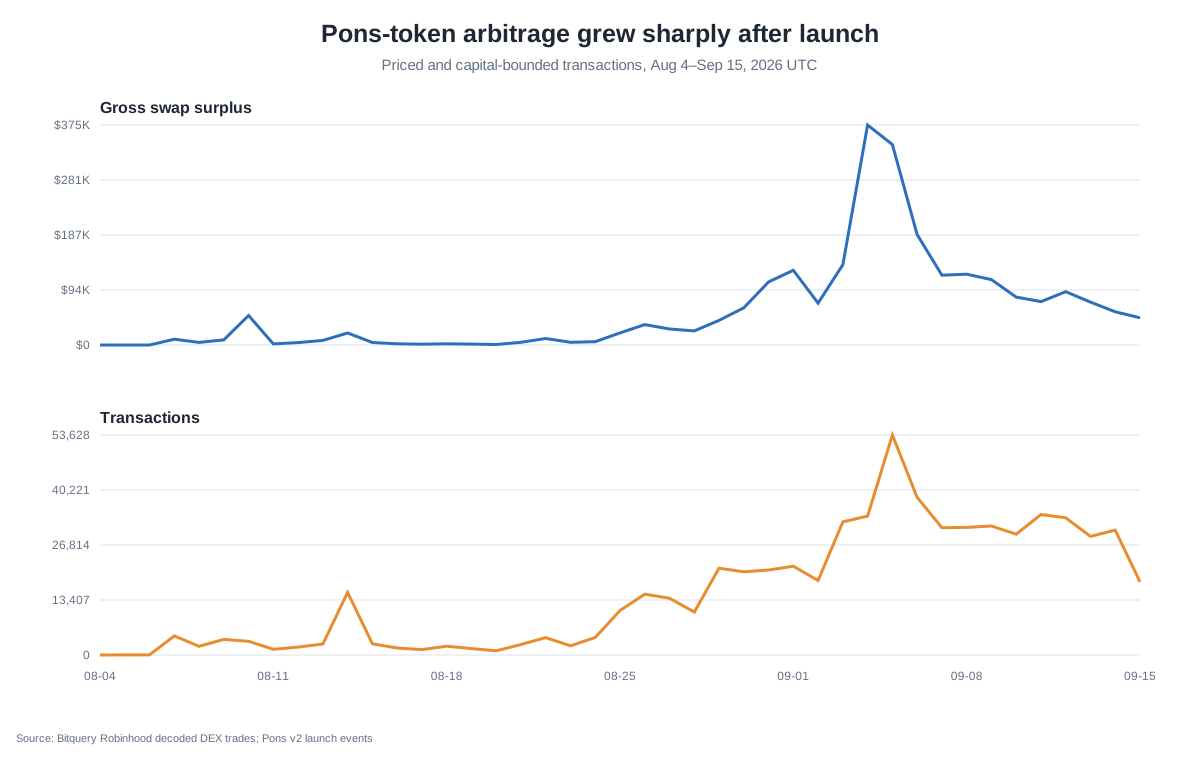
September alone booked $4.23 million. By October the market had shrunk. From 10 October to 16 October it booked $14,194 per day, against $597,173 on its best day.
07 · The coinsThe top coin took 6% of the surplus
The surplus spread across many coins. Shivolink led, with MUSHROOM in second place. The top five took 19% of the full sum.
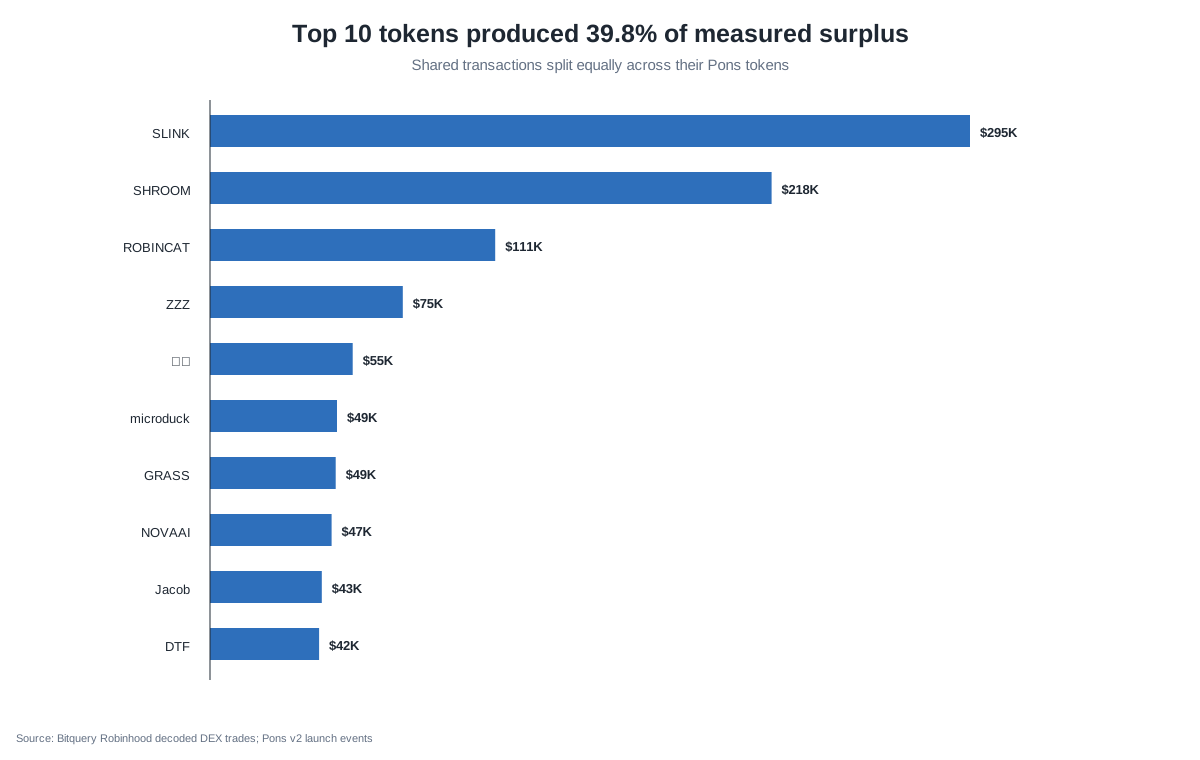
| Pons token | Swap surplus · share |
|---|---|
| Shivolink · SLINK | $319,679 · 6.05% |
| MUSHROOM · SHROOM | $276,232 · 5.22% |
| ROBINCAT | $150,614 · 2.85% |
| ZZZ | $149,391 · 2.83% |
| ubik | $122,663 · 2.32% |
When one tx crossed several Pons coins, we split its value between them for this table. That keeps the coin rows equal to the full sum.
08 · The poolsUniswap v4 sat at the center
Of all trades, 47% stayed within Uniswap v4 pools and 41% crossed between v3 and v4. Together, those two routes held 87% of trades and 95% of the swap surplus.
| Pool route | Trades · gross surplus |
|---|---|
| Uniswap v4 pools | 832,056 · $2.04M |
| Uniswap v3 + v4 | 725,770 · $2.96M |
| PancakeSwap v3 + Uniswap v4 | 88,515 · $154,057 |
| Uniswap v3 pools | 27,913 · $23,502 |
The same exchange can host an arbitrage trade when its pools quote the same coin at different prices. The price gap sits between pools, even when one DEX name appears on both sides.
09 · The auditRaw transfers back the corrected total
Swap records are one view of a trade. Raw token transfers and Uniswap v4 claim records are another, and they do not depend on how the swaps were read. For 454 sampled trades, we rebuilt each gain from those records alone. We counted every wallet on the trading side and left out the Uniswap v4 contract, the hooks and their fee contracts, the pools and WETH.
We first measured the cut as payments from Uniswap v4 to the hook. A re-check on 18 October measured it on the hook side instead. That lowered the total by $442 and added 16,007 trades, so the sample also covers the trades the re-check changed.
| Sample group | Trades · from swaps · from transfers |
|---|---|
| Hook pays its cut out | 40 · $135,187 · $135,187 |
| Hook keeps its cut as a claim | 80 · $2,900 · $2,900 |
| Hook donates its cut to the pool | 40 · $1,280 · $1,280 |
| Cut passes through a fee contract | 40 · $805 · $1,026 |
| Router donates part of the output | 80 · $1,668 · $1,668 |
| Hook pool with no cut | 40 · $3,747 · $3,747 |
| Changed by the hook-side re-check | 104 · $2,194 · $2,195 |
| No hook pool (control) | 30 · $51,255 · $51,255 |
In every group but one, the two sums agree to within a dollar. The fee contract group runs high because one of its trades also swaps on a pool missing from the audit's pool list. For that trade, the bot's own wallet gained exactly the swap figure.
A second build, written from the rules alone with its own queries, redid 8 October. It matched our first measure on every figure.
The total still measures swap surplus, which can differ from wallet profit. The transfers showed bots passing part of their gain to other wallets. A tx may also repay a loan or tip someone after the swaps finish. The largest single tx booked $28,839, under one percent of the total.
10 · The limitsWhat the total leaves out
The headline covers the verified Pons v2 launch set. A possible older factory stayed out because we could not prove its link to Pons well enough for a public total.
Only ETH, WETH and the checked USDG coin could price a gain. Trades that finished with another coin stayed out of the dollar sum. Other trades failed the balance check. We did not count either group in the headline total.
We checked hooks on Uniswap v4 only. PancakeSwap pools with hooks were not checked. We also cannot see liquidity changes on v2 or v3 pools that a tx did not swap on.
Each day's median WETH/USDG DEX price gave us the dollar value of WETH. USDG was set to one dollar. We did not split trades by whether the coin had left its Pons curve at that moment.
Anyone can rerun the DEX side with Bitquery's DEX Trades API. The same raw stream is in Blockchain Data Streaming, and the queries can also be tested through the Bitquery MCP server.
Query Robinhood Chain DEX trades
Track swaps, pools, tokens and tx fees from the same on-chain data used in this study.
This analysis covers verified Pons v2 tokens on Robinhood Chain from the first launch on 3 August through 16 October 2026 UTC. It measures token balance changes inside decoded DEX swaps, takes off the cut that Uniswap v4 hooks keep in the same transaction, measured on the hook side, and prices only positive ETH, WETH and verified USDG balances. The totals subtract the sender fee but do not subtract direct transfers, flash-loan repayment, builder payments or off-chain costs. They are swap surplus figures, not claims about wallet profit. The analysis does not identify the people or firms behind any address. This article was corrected on 18 October 2026. The first version, published on 17 September 2026, did not take off the hook cut and put the swap surplus for 3 August to 15 September at $2.48 million; the corrected figure is $4.41 million.
This article is provided for informational and educational purposes only. It reflects analysis of publicly available on-chain data as of the dates given, and does not constitute legal, financial, compliance, tax or investment advice, nor a recommendation or offer to buy, sell or hold any asset. Blockchain addresses are pseudonymous: a transaction between two addresses does not by itself establish the identity, intent or knowledge of any party, and every entity attribution here is an inference that may be incomplete or wrong. Readers should verify independently before acting on anything above, and Bitquery accepts no liability for loss arising from reliance on this material. All trademarks and company names are the property of their respective owners. Corrections and right-of-reply requests go to support@bitquery.io.
Written by Bitquery Research with AI tools; every figure was checked against the raw data.