A $19 pool shows $579 million of liquidity. One bot is a quarter of Raydium CLMM.
While measuring how much money sits behind DEX prices, we kept finding Raydium pools that traded thousands of dollars a minute against twenty dollars of USDC. All of them were named after exchange-listed coins. All of them were traded by the same few wallets. We followed the wallets back to March.
- 22.7%
- 438
- 22 s
- $5.9B
- 7th
01 · The poolA pool that holds $19
Search for Lisk on DEXScreener and the first result is a Raydium pool on Solana. The price shown sits close to the real Lisk price on exchanges. The market cap and the liquidity are both shown at over half a billion dollars. The pool traded tens of thousands of dollars in the last day. Jupiter's token search returns the same token, unverified, with the same day's volume.
Lisk has no official token on Solana. The token in that pool was minted in mid September with a supply of one billion, and almost all of it sits in the pool. The other side of the pool holds nineteen dollars of USDC.
| The fake LSK pool, 4217AZ52r8FQr9GibnFahut1MEkB9pHYv4qTHcuEmVs6 | Value |
|---|---|
| What DEXScreener displays as liquidity | $579,334,583 |
| What DEXScreener displays as market cap | $579,509,790 |
| Volume and swaps in the last day on DEXScreener | $90,525 in 22 swaps |
| USDC in the pool | 19.27 |
| LSK in the pool, out of 1 billion minted | 999,697,630 |
| Price in the pool / real LSK price on Binance-style venues | $0.5795 / about $0.58 |
| Swaps in 30 days | 593, by 4 wallets |
| Volume in 30 days | $3.80 million |
| Token mint | 4J1etgPiC5mUvdssR5k6HWkjpdsDmMLADw6gFzgZiJuC, created 16 September 2026, 13:12 UTC, by Z71T3gsDLLUDDLBhR8VErh55M8KXaybyAUikPKWDxBM |
The liquidity figure is arithmetic. Price screens value both sides of a pool at the pool's own price. A billion tokens at the displayed price is half a billion dollars, whether or not anyone would pay that for them. The USDC is the only money in the pool that anybody else issued.
Bitquery's Trading API reports liquidity the other way round, as the quote-side reserve that actually backs a price. We scanned Solana for pools with under a thousand dollars of measured reserve and thousands of dollars of hourly volume. That turned up this pool, and hundreds like it.
02 · The tripTwenty-two seconds
Every swap in the LSK pool in the last month came from the same four wallets. The one that matters is 8RvqEo9pqTmzhPbaEcnENY9WXJdRqHFWQVFqKA7QCCs5. Twice a day it does the same thing.
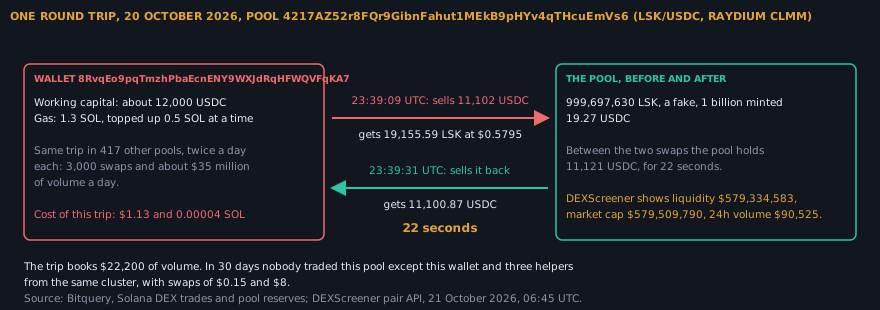
The pool is a Raydium CLMM pool, so the wallet's own position absorbs the swap with almost no price impact. The price barely moves, the USDC comes back, and the pool's chart shows two trades at the going rate. Because the price stays where the bot put it, the market cap and liquidity figures on the screens stay put too.
The same wallet runs the same trip in hundreds of other pools. On a typical day that is about three thousand swaps and thirty-five million dollars of USDC in and out, for about two dollars in network fees.
| Wallet 8RvqEo9pqTmzhPbaEcnENY9WXJdRqHFWQVFqKA7QCCs5, 30 days to 21 October 2026 | Value |
|---|---|
| Swaps | 108,871 |
| Volume, each swap valued at its USDC side | $1.41 billion |
| Pools traded | 438, all Raydium CLMM, all against USDC |
| Average swap | $12,962 |
| Median time between a buy and its matching sell | 20 seconds |
| Completed round trips | 22,685 |
| Working capital | about 12,000 USDC and 1.3 SOL |
| Network fee per swap | 0.000020001 SOL |
03 · The scaleA quarter of Raydium CLMM
Raydium CLMM is Raydium's version of the Uniswap v3 pool design, where each provider picks a price range. Over the thirty days in the chart below it recorded a little over six billion dollars of volume on Solana. This one wallet produced close to a quarter of it.
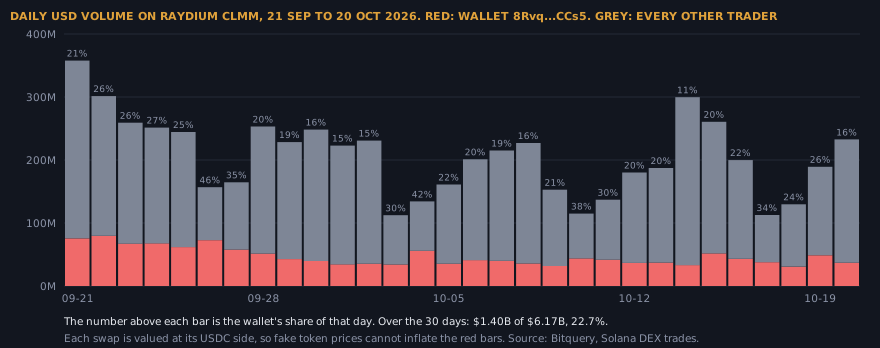
The share holds up because the volume is real USDC changing hands. We valued every swap at the lower of its two sides, which for these pools is always the USDC. A fake token priced in the hundreds of dollars cannot inflate a bar. What inflates the protocol's number is that the same eleven thousand dollars goes in and out of a pool thousands of times a day.
Ranked against every DEX trader on Solana by that same measure, the wallet sat seventh in the last full day before publication. First place belonged to a wallet Bitquery's labels mark as Wintermute's automated liquidity bot. The wash wallet got there with under three thousand swaps. Every other wallet in the top ten needed tens of thousands to over a million.
| Solana DEX traders by USD volume, 24 hours to 21 October 2026, 06:57 UTC | Volume / swaps |
|---|---|
| 1st, MfDuWeqSHEqTFVYZ7LoexgAK9dxk7cy4DFJWjWMGVWa, labeled Wintermute automated liquidity bot | $129 million / 114,349 |
| 2nd, AgmLJBMDCqWynYnQiPCuj9ewsNNsBJXyzoUhD9LJzN51, labeled as the fomo app's contract | $120 million / 1,664,410 |
| 3rd, FkaLnX17cXZGyeu3kZGdHCNdFMJJzBrPPYVvd18B3MZp | $84.9 million / 68,362 |
| 7th, 8RvqEo9pqTmzhPbaEcnENY9WXJdRqHFWQVFqKA7QCCs5, the wash wallet | $34.2 million / 2,952 |
04 · The factoryFake majors, deposit networks, and a gas wallet
The tokens are built to be found. We looked at four hundred that the main wallet traded in one twelve-hour stretch. The most common tickers were XMR, LTC, XLM, XRP, HBAR and TAO. Next came stablecoins named after deposit networks. Three patterns stand out.
| Naming pattern | Examples among the cluster's tokens |
|---|---|
| Exchange-listed coins with no native Solana token | XMR, LTC, HBAR, TAO, XRP, XLM, ADA, TRX, BNB, KAS, LUNC, ZEC, LSK, BTC, ETH |
| Stablecoins named after a deposit network | TRC20-USDT, ERC20-USDT, BEP20-USDT, USDT-TRC20, SOL-USDT, USDC-BSC, USDC-TRC20, TRON-USDT |
| Recent launches and hype names | HYPE, PUMP, PONS, BLESS, EDEL, GRVT, HEMI, RLUSD, PAXG, SpaceX, TRUMP, WORLDCUP |
Prices are set to look right at a glance and then left. Of the fake tokens whose ticker matches a Binance market, fewer than one in eight sit within five percent of the real price. The fake XMR trades at more than four times the real one. The fake TRX, XRP and RLUSD track their originals closely.
| Fake price against the real asset, Binance spot, 21 October 2026 | Count or price |
|---|---|
| Fake tokens whose ticker matches a Binance market | 175 |
| Priced within 1% of the real asset | 8 |
| Priced within 5% of the real asset | 20 |
| Fake XMR in its pool / real XMR on Binance | $547 / $119 |
| Fake TRX in its pool / real TRX | $0.331 / $0.331 |
Each token's name and logo are controlled by a throwaway wallet. The fake LSK was created by the same wallet that controls its name. The fake XMR and the fake ZEC came from one factory wallet, which has minted close to a hundred tokens since late September. Thirty-one different naming wallets appear across the thousand tokens we sampled.
The wallets share one source of gas. One wallet sends SOL, half a coin at a time, to the trading wallets and to the token-naming wallets alike. It topped up the main wallet four times in October. It funded the wallet that funded the first bot. The SOL circulates inside the cluster, and we found no exchange deposit or withdrawal at the edge of it.
| Who made what | Wallet and record |
|---|---|
| Fake LSK creator and metadata authority | Z71T3gsDLLUDDLBhR8VErh55M8KXaybyAUikPKWDxBM, 16 September 2026, 13:12 UTC |
| Token factory: fake XMR, fake ZEC and 91 more since 28 September 2026 | Fxez98FHK9FRkZPzUjzwLFocQh1DymXmUifpnKJ1j9ib, 93 tokens |
| Gas wallet | 3QG3aFvShbd6SxN3SdPowYQbokfReLGV6L141kMJQoLc, 0.5 SOL to the main wallet on 2, 5, 9 and 19 October 2026 |
| Metadata authority wallets across 1,000 sampled tokens | 31 |
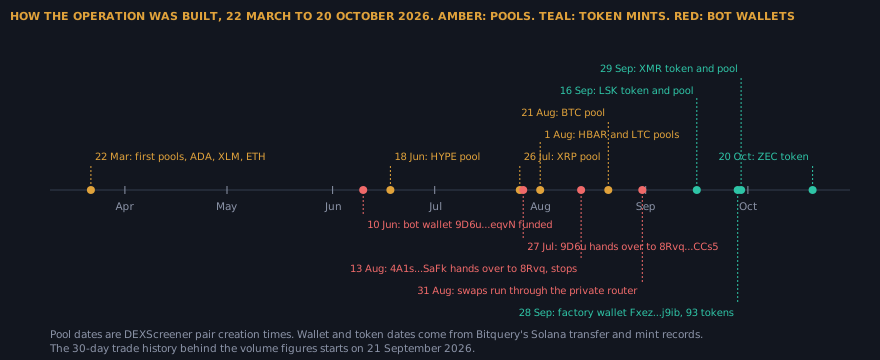
The bot has had three bodies. The first received its SOL in June and traded the same pools until late July. Then it passed its remaining SOL to the current wallet and went quiet. A second body, with over three hundred thousand transfers behind it, sent its last SOL to the same wallet in mid August. Twenty minutes later the new wallet was doing round trips. The pools it trades are older still: the fake ADA, XLM and ETH pools were created in late March.
| Handover | What the ledger shows |
|---|---|
| First body, 9D6u9xbEzSL8ETwodtrxyLDz7HL7iBettMrAbPMAeqvN | First SOL received 10 June 2026; sent 1.096 SOL to the main wallet on 27 July 2026 and stopped |
| Second body, 4A1snSJmJyibf69mHVpzUBzeLTMrdzd88QgdQyv8SaFk | 320,000 transfers; last one 1.3458 SOL to the main wallet on 13 August 2026, 15:44 UTC |
| Main wallet's first round trips | 13 August 2026 from 16:05 UTC, 16,664 USDC each |
| Oldest pools: fake ADA, XLM, ETH | Created 22, 25 and 27 March 2026 |
| Private router program, routeUGWgWzqBWFcrCfv8tritsqukccJPu3q5GPP3xS | Carrying the main wallet's swaps by 31 August 2026; called by 654 wallets in the week to 21 October |
Since at least the end of August the swaps have gone through a program of the cluster's own. Hundreds of wallets have called it in the last week. Every handover in the table is a public transfer. To follow one yourself, trace the wallet's transfers in Claude with the Solana MCP.
05 · The screensWhat the aggregators show
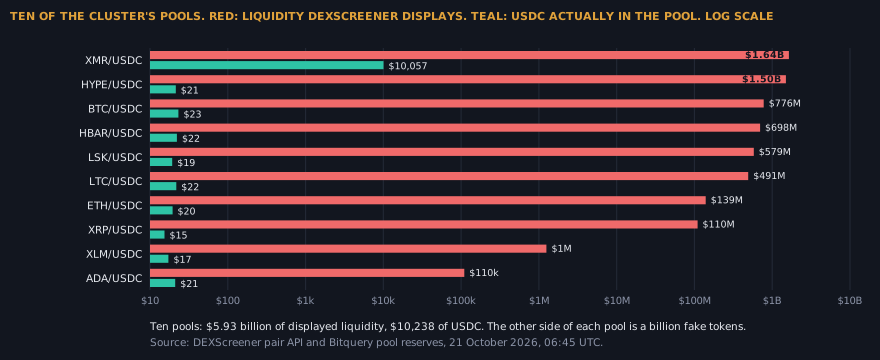
Search DEXScreener for XMR and seven of the top ten results are the cluster's Raydium pools. Each shows a billion dollars or more of liquidity. They rank above the real wrapped Monero market on Meteora. Jupiter's search returns the fake LSK, tagged unknown, with its day of volume. Neither screen is wrong about what it measured. Both are measuring a number the bot controls.
The cluster also pads the trader counts. Twelve helper wallets made over a million swaps in the same month, most of them under twenty cents. Their job is to make each pool show more than one trader.
| Helper wallets, 30 days to 21 October 2026 | Swaps / volume / pools |
|---|---|
| All twelve together | 1.25 million swaps / $8.8 million |
| ProCXqRcXJjoUd1RNoo28bSizAA6EEqt9wURZYPDc5u | 365,018 / $1.13 million / 4,500 pools, average swap $3 |
| FUNDduJTA7XcckKHKfAoEnnhuSud2JUCUZv6opWEjrBU | 204,097 / $233,842 / 3,921 pools, average swap $1 |
| J2MFHpjZWp6e6tkFXtfF1qQQqBP57yfQv8WnyJGEwgxN | 94,917 / $2.55 million / 496 pools, average swap $27 |
| 3G6j2KgkWrDM7JoBTrhP4NmkcwACvZnaEeyB4CeeQ7Up | 83,950 / $1.38 million / 487 pools, average swap $16 |
| Four wallets with 15-cent swaps, 65,000 to 76,000 each | H4gKYRmQ2Hci3czL8rsdU6mne9MULdTCaSJDsiawQ72L, 6gCgASZSfzRZ2fY2ex8fqUwjLrMV9Wcm3YpLhbwiUSpg, Eh7L3kGmj7ZxJptSn3cWvjYZciuP4sHBkCVHMjxyjhYE, 39aDuA7Dnm2fKnmsr7PD7hvTAGEaN1yxkiHDuqSneJsR |
06 · The pointWho it is for
Almost nobody outside the cluster has bought in. In the last week, four wallets that are not part of it traded one of the pools once each, for about twenty-seven dollars between them. Every dollar of the volume came from the cluster and went back to it.
So the volume is not there to profit from a trade. It is there to be seen. A token called LSK with a steady day of volume and half a billion dollars of displayed liquidity ranks on screens that sort by those numbers. A token called "TRC20-USDT" at a dollar is the kind of thing a person pastes into a swap by mistake. The ledger shows the bait being set. It does not yet show anyone taking it, and we did not find a sale by the cluster to an outsider at any price.
What the ledger does show is how cheap this is. The whole thing runs on about twelve thousand dollars of working capital and half a SOL of gas at a time. Each trip loses about a dollar. For that, one wallet is a fifth of a major protocol's volume. Ten of its pools display more liquidity than most real tokens have market cap. We have measured Solana's volume bots before, and a counterfeit SOL wash machine, and wash trading across six chains. This is the same trick with a new target: the liquidity number itself.
Volume is the sum of DEX swaps on Solana, each valued at the lower of its two priced sides. For these pools that is the USDC side. Raydium CLMM's total is the sum over every swap on the amm_v3 program in the same 30 days, from Bitquery's Solana trade records. The 30-day window is the depth of the trade history used; the pools and wallets are older than it.
The cluster is the main wallet, the twelve helper wallets, the gas wallet, the metadata authorities and the factory wallet, tied together by shared pools, shared gas and direct transfers. No statement from whoever runs it exists. Each wallet is described by its behaviour and attributed to nobody.
Pool reserves and the Bitquery liquidity figures are quote-side reserves at the moment of the last swap. DEXScreener and Jupiter figures were read from their public APIs on 21 October 2026 at about 06:45 UTC and will have changed since.
Real-asset prices used for the comparison are Binance spot prices on 21 October 2026 at about 06:30 UTC, matched by ticker. A token whose ticker matches no Binance market was left out.
An earlier pass at this data used Bitquery's realtime Solana dataset, which holds only the most recent hours of raw trades and transfers, and wrongly dated the operation to 20 October. The dates here come from the full transfer history and from DEXScreener's pair records.
07 · The recordAddresses behind this story
FAQ
Is the LSK token on Solana real?
No. Lisk has no official Solana token. The one DEXScreener and Jupiter show was minted in September by a wallet in this cluster. The only money in its pool is about nineteen dollars of USDC.
How can a pool with $19 in it show $579 million of liquidity?
Price screens value both sides of a pool at the pool's own price. The pool holds a billion fake tokens. The bot keeps the price near the real Lisk price. A billion times that price is over half a billion dollars. The USDC side is the only part anyone else issued.
How much of Raydium CLMM's volume is this?
Close to a quarter. Over the thirty days in the chart above, the main wallet produced $1.40 billion of the $6.17 billion traded on Raydium CLMM. On its heaviest day it was nearly half. Every swap is valued at its USDC side, so the figure counts real USDC moving.
Who is behind it?
We do not know. The wallets carry no labels, the gas moves between them without touching an exchange, and the token metadata is held by throwaway authorities. The piece names wallets and describes what they did.
Has anyone lost money?
Not that the ledger shows. Four wallets outside the cluster traded one of the pools once each in the last week, for about twenty-seven dollars in total. The pools look like bait for people searching a ticker or pasting a "USDT" token by mistake. No outsider has yet bought into one at size.
How was this found?
By measuring liquidity rather than volume. Bitquery's Trading API reports the quote-side reserve behind each pool's price. We filtered Solana for pools with under a thousand dollars of measured reserve and thousands of dollars of hourly volume. The cluster's pools came up, and the wallet trace followed from there.
This article is provided for informational and educational purposes only and reflects analysis of publicly available on-chain data as of the dates indicated. It does not constitute legal, financial, compliance, or investment advice, and nothing in it is a recommendation to buy, sell, or hold any token or asset.
The findings describe swaps, transfers and token mints observed in Solana data between March and 21 October 2026, together with the rules used to value them and to group wallets. The cluster is an inference from shared pools, shared gas funding and direct transfers between wallets. Attributions come from Bitquery's address labels and on-chain behaviour; they may be incomplete or incorrect and may be revised as more data becomes available. Solana addresses are pseudonymous, and an unlabeled address is described by its behaviour and attributed to nobody.
References to Raydium, DEXScreener, Jupiter, Wintermute, Binance, Lisk, Monero or any other named project describe on-chain records and public data feeds, and are not statements about any entity's conduct, knowledge or intentions. Figures read from third-party screens are reported as they appeared at the time stated. Newly launched and unverified tokens carry a high risk of total loss.
Nothing herein should be relied upon as a definitive determination of fact. Readers should conduct their own independent verification before taking any action. The authors and publisher accept no liability for any loss or damage arising from reliance on this material. All trademarks and company names are the property of their respective owners.
Reported by Divyasshree for Bitquery Research, with AI tools; every figure was checked against the raw data.
Check a pool's real reserves before you trust its liquidity
The figures above come from Bitquery's Solana data: every DEX swap, every pool's reserves after each swap, and every transfer and mint behind the wallets. The Solana DEX API gives you the trades, and the Bitquery MCP is how the wallets, their funding and the token creators were traced.