How Webacy Uses Bitquery to Support Digital Asset Risk Intelligence
Webacy's CEO sets out which Bitquery data her team uses and how it supports token risk, fund-flow analysis and stablecoin monitoring.
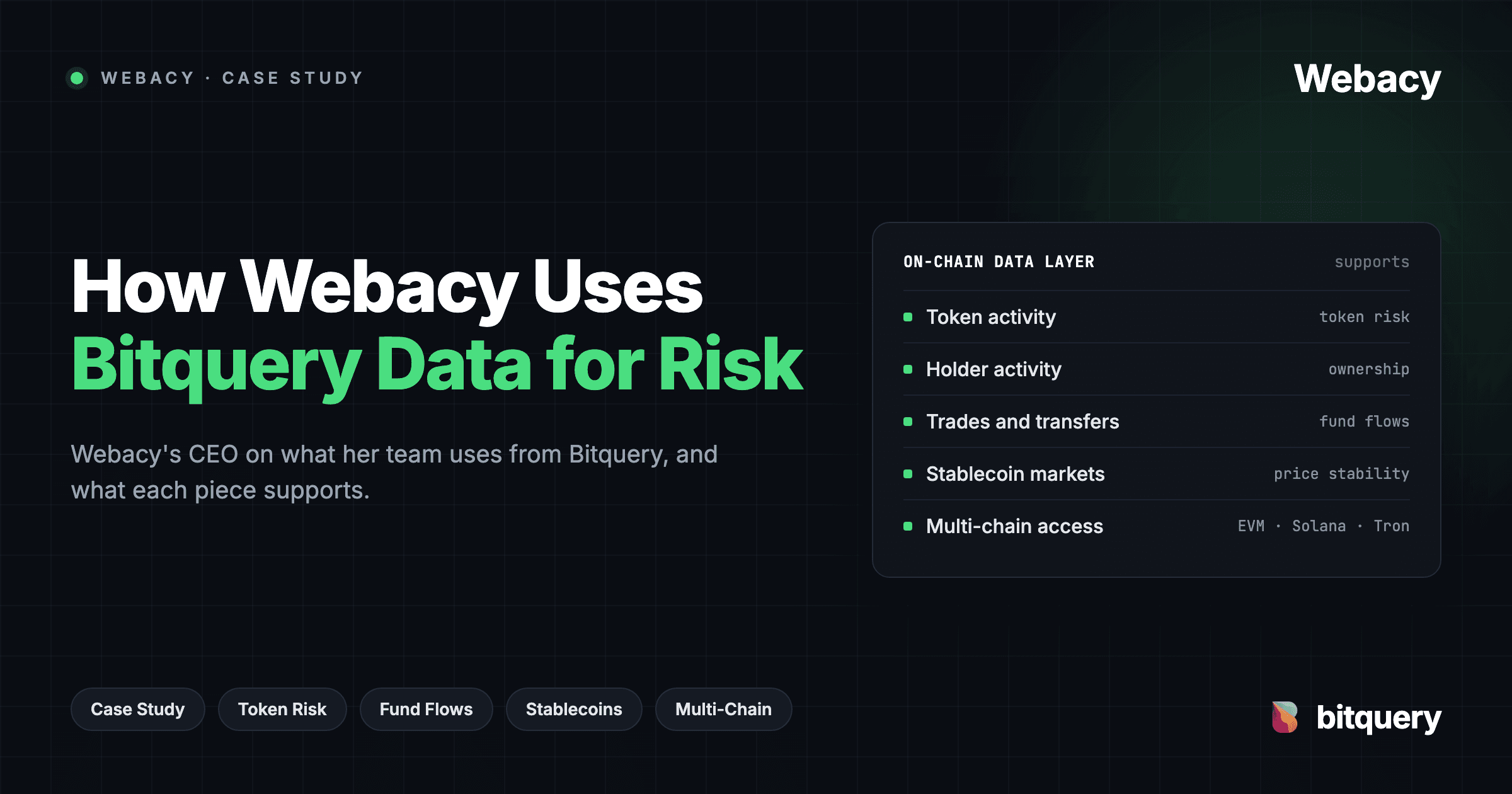
Webacy provides risk intelligence for digital assets. Businesses use its products to evaluate tokens, assess counterparties, trace fund flows and watch for new risks.
Bitquery contributes one layer of the on-chain data that supports those products. Webacy uses that layer alongside its own analysis and other sources. Maika Isogawa, Webacy's CEO, sent us a written account of what her team uses from Bitquery and what each piece supports.
"Bitquery provides the infrastructure we rely on every day. Fast, reliable, and comprehensive across the chains that matter to our business."
Maika Isogawa, CEO, Webacy
What Webacy uses from Bitquery
The account lists five things.
| From Bitquery | What it does for Webacy |
|---|---|
| Token activity | Gives behavioral context to token risk assessments |
| Holder activity | Helps inform analysis of token ownership and distribution |
| Trading and transfer history | Supports analysis of wallet behavior and of how funds move across addresses |
| Stablecoin market activity | Contributes to monitoring of stablecoin market conditions and price stability |
| Multi-chain access | Gives API access to indexed blockchain data across EVM networks, Solana and Tron |
Support for Webacy's products
Token risk. Bitquery data contributes to assessments of token activity, ownership patterns and potential risks. Those assessments help Webacy's customers make better-informed decisions.
Fund flows. Transfer data supports visibility into how funds move and how wallets relate to each other.
Stablecoin monitoring. Webacy monitors stablecoin stability and new market risks, and on-chain market data adds context to that work.
Coverage across chains. Access to several networks through a consistent interface supports broader coverage.
What Webacy gains
The account names three gains.
- Less infrastructure work. Indexed data reduces the infrastructure work needed to access and analyze blockchain activity.
- History. Historical records help Webacy assess behavior over time.
- More context. On-chain data from Bitquery complements Webacy's own risk intelligence and supports its broader analysis.
Together, these help Webacy deliver risk intelligence through its APIs and products. That lets customers build digital asset due diligence and monitoring into their own workflows.
The same data for your risk product
The Bitquery API is available to any team. Bitquery indexes token transfers, balances and DEX trades on Ethereum and other EVM networks, on Solana and on Tron. The compliance solution page covers risk scoring and monitoring. The Nansen case study shows Bitquery behind live trading prices.
To talk through a risk or compliance product, contact our team.
This case study is based on a written account that Maika Isogawa sent us on 2 October 2026, and on a quote she supplied in June 2026. AI tools helped turn the account into this page.
Subscribe to our newsletter
Subscribe and never miss any updates related to our APIs, new developments & latest news etc. Our newsletter is sent once a week on Monday.