A month after launch, Arc lost 94% of its daily users. Its lending market filled up
A new chain from the company behind USDC drew a huge first-day crowd. Four weeks of the record show who stayed, who was never a person to begin with, and where the money actually went.
- −94%
- $190M
- 60%
- 32%
- 92%
- 5.3×
01 · Launch dayA crowd for a new kind of chain
In mid-September, Circle opened its own blockchain to everyone. Circle is the company that issues USDC, a digital dollar. Its new chain is called Arc. On the first day, hundreds of thousands of wallets used it.
They came for everything at once, as our launch-day study found. People bridged in dollars, launched tokens by the tens of thousands, and traded them within minutes. Arc charges its network fees in USDC instead of a separate coin, and on that first day users paid more in fees than in the next six days combined.
A month later, almost all of that crowd is gone. Bitquery indexes every block on Arc, so we followed every transaction from launch to 14 October. The month splits in two. Retail use fell 94% from launch day to the fourth week. One market grew the whole time: lending, where traders borrowed USDC against Circle's own tokenized bitcoin. Between the two sits a thick layer of wallet farms, where one person creates thousands of addresses, and trading bots. Both make the chain look busier than it is. We separate them out, then follow the money to see who holds it and where it goes.
02 · What Arc isA chain built around one company's dollar
Most blockchains have their own coin, and you need some of it to pay fees. Arc does not. Fees are paid in USDC, so anyone holding dollars on Arc can use it straight away. Circle creates USDC on Arc when someone deposits dollars with it and destroys it when they are redeemed, so the total on the chain moves with real deposits.
Money also arrives through bridges, services that move USDC from another blockchain by destroying it there and creating it here. Circle runs two of them, CCTP and Gateway. On top of the chain sit the usual apps. Exchanges let tokens trade against USDC, and launchpads let anyone create a token in one click. Morpho, a lending app, lets you post one asset as collateral and borrow another.
Circle also issues a tokenized bitcoin on Arc, cirBTC, alongside its euro coin EURC. Those two and USDC are the assets that matter here. Many other "stablecoins" and "stock tokens" on Arc turned out to be copies: 1,451 contracts other than Circle's call themselves USDC.
03 · The crowd94% gone, and many were never people
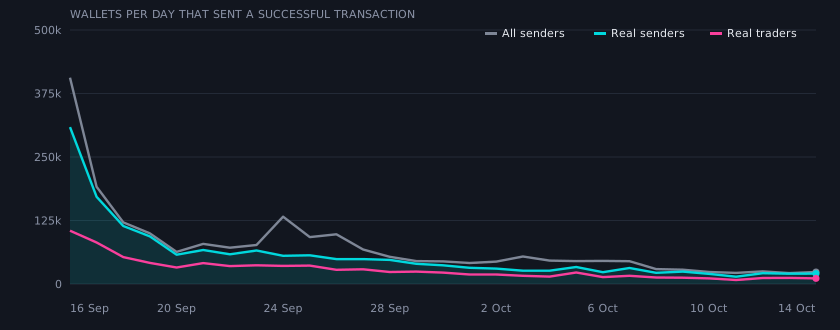
Every measure of use peaked on the first day. Active wallets fell by half on day two and kept sliding. Of the wallets that first appeared on launch day, about one in thirty was still active in the last week.
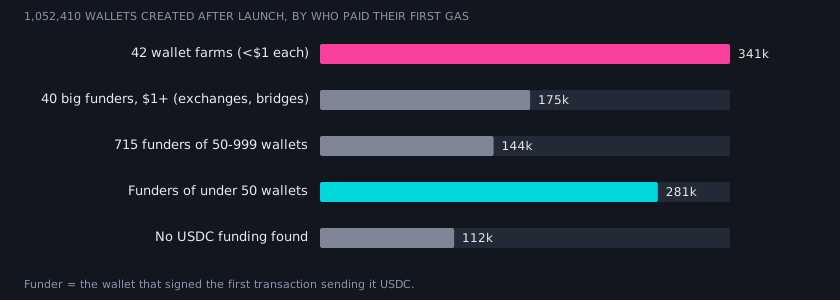
Part of the first-day crowd was never a crowd. A wallet needs a little USDC to pay its first network fee, its gas, so we traced who paid for each new wallet's first transaction. Forty-two senders each paid for 1,000 or more brand-new wallets, almost always with less than a dollar apiece. That is the signature of a wallet farm: one person creating thousands of addresses to look like thousands of users, usually to qualify for a future reward. We have seen the same pattern in airdrop farming on other chains.
| Wallet farm | What it did |
|---|---|
| 0xf56e…0d33, 21 Sep to 14 Oct | Funded 122,292 new wallets with $0.004 each. Each made one swap; 117,895 sold the GLITCH token for 24 cents in total. |
| 0x5d72…a5d5, 24 to 28 Sep | Funded 72,045 new wallets with $0.01 each, 63,559 of them on 24 Sep alone. They approved the KAWAY token and swapped through one router. |
| 0xfea8…314e, 23 Sep to 5 Oct | Funded 20,174 new wallets with $0.02 each through a batching contract. |
| All 42 farms | At least 340,931 of the 1,052,410 wallets created after launch, or 32%. A floor: farms that pay more than $1 per wallet, or fund through tokens, are not counted. |
At the other end sit the bots. About fifteen hundred wallets sent thousands of transactions each, and by the last week they sent four in five of all transactions on Arc. Set them aside, along with the farms and one outsized trader. What remains is the teal line in the first chart, a real crowd that shrank about as fast as the headline one.
04 · TradingVolume held up because of a few wallets
Daily trading volume did not fall with the user count. It held up for most of the month, while nine in ten traders left. That gap is a handful of wallets.
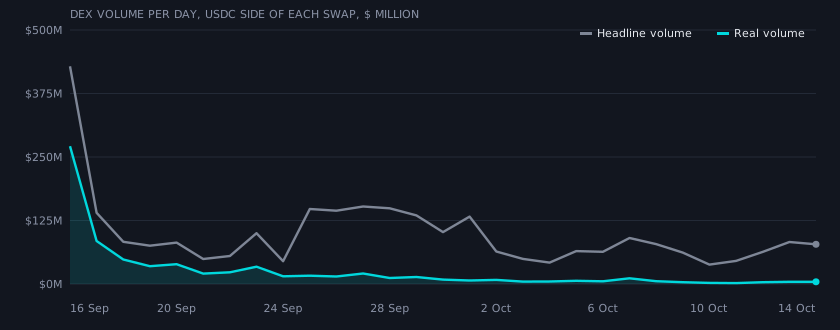
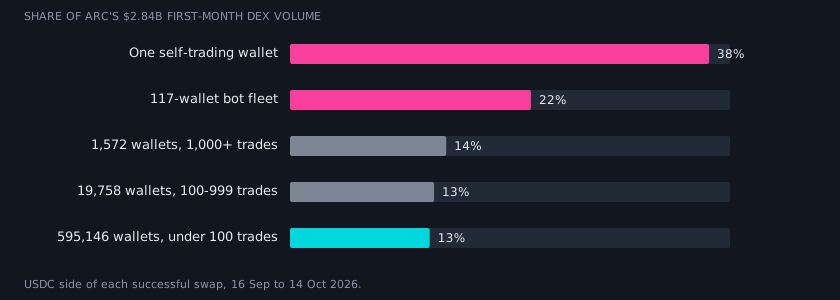
The single largest trader is the wallet our earlier Arc investigation caught trading against itself. It kept going all month. In October it moved to copycat tokens that borrow real tickers, a fake cirBTC, a fake WETH and a fake EURC, and pushed hundreds of millions of dollars of volume through them. Any site that ranks tokens by symbol rather than by address would count that as real trading in those assets. The wallet paid about a hundred dollars in network fees for a billion dollars of volume.
The bot fleet is less hidden than it looks. A single transaction funded fifty of its wallets in one second on launch day. Another transaction, from a different wallet two hours earlier, funded forty-seven more, and some of those later sent their USDC back to it. Two funding wallets, in other words, seeded 97 of the 117 bots, and money has moved between the two groups.
05 · LaunchpadsA token factory that ran out of buyers
In launch week, one launchpad, Argus, created tens of thousands of tokens per day. By the last week it was making about a hundred. Only about three in ten of its tokens ever traded against USDC, and sixty-five creator wallets made more than half of all its launches between them.
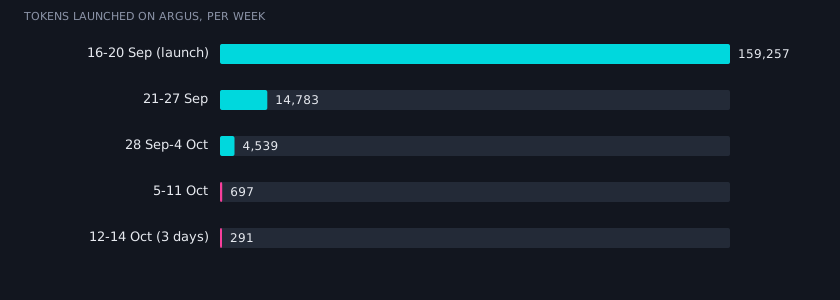
The question for anyone who bought is what the creators did next. We counted a creator sale whenever the wallet that launched a token sent that token out and received USDC back in the same transaction.
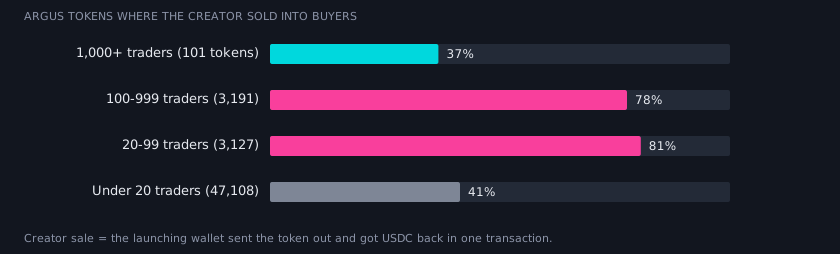
These are floors. A creator who sold through a second wallet is not counted, and the totals are gross: they do not subtract what a creator spent buying its own token at launch. A token that drew a few hundred buyers usually had a creator selling into them within the hour.
06 · The moneyWhere Arc's dollars came from, and who holds them
USDC on Arc grew by more than half in the month. It rose for one reason: Circle created new USDC directly for a few large accounts. Ordinary bridge traffic went the other way, and more money left Arc through Circle's CCTP bridge than arrived.
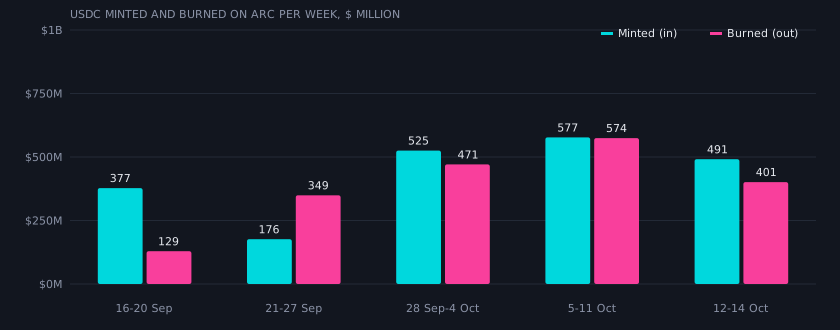
The dollars on Arc sit in very few places. In mid-October, two dozen addresses held nine in ten of all the USDC on the chain. Of the addresses holding any USDC at all, only about one in ten held a dollar or more.
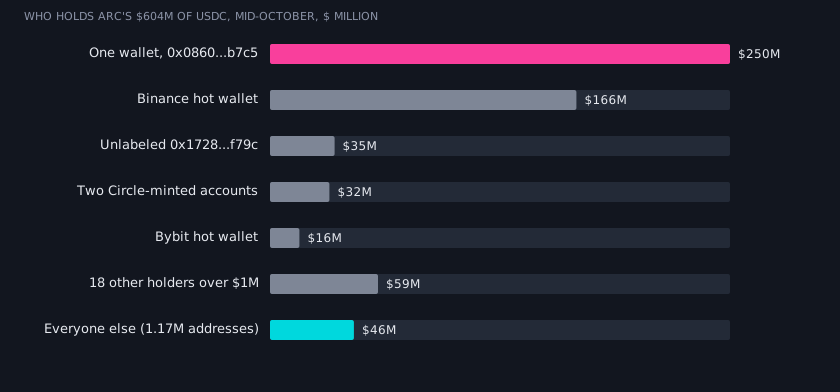
| Holder | What the record shows |
|---|---|
| 0x0860…b7c5: $250M | Has sent one transaction ever. Received $100M, $75M and $75M in USDC from 0x7b79fd67…e1d5 after a $5 test. The first $100M left Binance's hot wallet on 18 Sep, reached 0x7b79fd67 through a second wallet two seconds later, and was passed on that night. Both $75M transfers came seconds after fresh USDC was minted to 0x7b79fd67. A lookalike address, 0x7b792e2a…e1d5, also sent this wallet a fake USDC token; that is not counted. |
| Binance hot wallet: $166M | Arc's one large exchange. It took in $497M from Arc wallets in the month and paid out $316M, including $100.5M sent straight to Bybit's hot wallet. |
| 0x4a0f…268d | Received $1.12B of newly minted USDC and 2,089 cirBTC. 66% of all deposits into Binance on Arc trace back to it. |
We could not tie a name to any of these three accounts. What the record does show is a path. Circle creates dollars on Arc for a few large accounts, and much of that money moves on to exchanges. For at least one large account, Arc already works as a route from Circle's minting to Binance deposits. For the public it is still a small chain.
07 · LendingThe one market that filled up
At launch, Morpho on Arc held well over a hundred million dollars of USDC that nobody had borrowed. A month later its main market, which lends USDC against cirBTC, is 97% lent out, and borrowing has gone from nothing to $190M.
The borrowers are few and large, and the six biggest owe about three quarters of the debt. Five of those six bridged every dollar they borrowed off Arc through CCTP, each to its own address on the other side, mostly on Ethereum. Arc is where they post bitcoin and pick up dollars. They spend the dollars somewhere else.
A loan like this has a limit. If bitcoin falls far enough that the debt passes 86% of the collateral's value, Morpho lets anyone repay the loan and take the bitcoin at a discount. That forced sale is a liquidation, and the price at which it starts is the borrower's liquidation line.
| Morpho USDC / cirBTC market on Arc | Value |
|---|---|
| USDC supplied, at launch and on 14 Oct | $148.1M and $194.9M |
| USDC borrowed, at launch and on 14 Oct | $0 and $189.8M (97% of supply) |
| Wallets that have borrowed / still owe | 264 / 218 |
| Debt owed by the six largest borrowers | $138M (73%) |
| Borrowed USDC bridged out by five of them | $142M: $132M to Ethereum, $10M to Base, Arbitrum and one other chain |
| cirBTC posted as collateral | 3,661 ($305M at $83,230) |
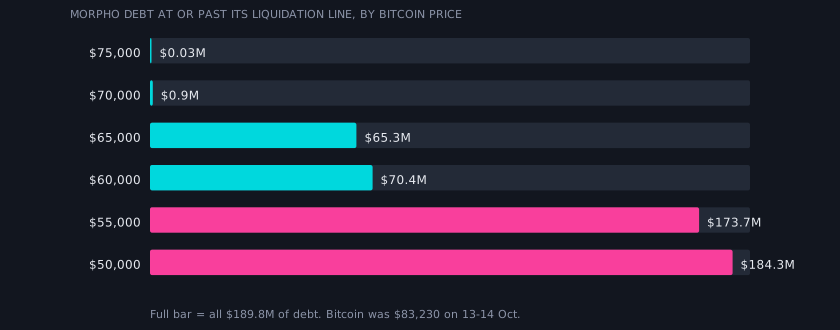
The chart shows two cliffs. The first comes if bitcoin loses about a fifth of its value, when a third of the debt reaches its limit. The second comes if it loses about a third, when nine in ten does. On a chain this concentrated, a sharp fall in bitcoin would be the first real test of its biggest market.
08 · A comparisonRobinhood Chain went the other way
Robinhood Chain opened to the public in early July, eleven weeks before Arc. We counted both chains the same way, by day since launch, without removing farms or bots from either.
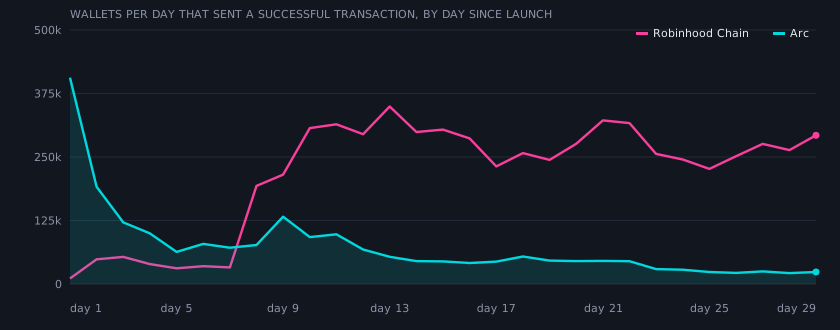
Robinhood Chain started smaller and grew 5.3-fold from its first full day. Arc started with a bang and kept 6% of it. By the fourth week Robinhood Chain had ten times Arc's senders and twelve times its traders. Robinhood's counts carry their own farms and bots, so the gap in real people is smaller than those ratios. Even so, one chain grew and the other shrank.
09 · What it adds up toA dollar rail first, a public chain second
After one month, Arc does one thing at scale. Circle creates dollars there for a few large accounts, those dollars move to exchanges, and borrowers post Circle's bitcoin to carry dollars to other chains. Those flows run to hundreds of millions of dollars.
The public side is small and shrinking. Real traders number about 11,000 per day. Launchpads have stopped producing tokens anyone wants. Much of the volume a dashboard shows comes from one wallet and one bot fleet. The question for Arc's second month is whether anything brings ordinary users back, or whether the chain settles into the role its first month already shows, as a back office for USDC.
FAQ
What is the Arc blockchain?
Arc is a blockchain built by Circle, the company that issues the USDC digital dollar. It opened to the public on 16 September 2026. Network fees on Arc are paid in USDC instead of a separate coin, and Circle also issues its euro coin EURC and a tokenized bitcoin, cirBTC, on it.
How many people use Arc?
Nobody can count people, only wallets. On launch day 406,006 wallets sent a successful transaction. In the fourth week the average was 24,678 per day. With wallet farms, heavy bots and the largest trader removed, about 20,000 real senders and 11,000 real traders were active per day.
How much USDC is on Arc?
About $599M at the end of the first month, up from $376M at launch. 24 addresses held 92% of it in mid-October, and one wallet alone held $250M.
What is cirBTC?
cirBTC is Circle's tokenized bitcoin on Arc. About 5,238 cirBTC existed after the first month, and roughly 70% of it was posted as collateral on Morpho to borrow USDC.
Is Arc trading volume real?
Partly. Arc's DEX volume averaged $64M per day in the fourth week, but real traders made about $3.6M per day of it. Over the month one self-trading wallet made 38% of all volume and a fleet of 117 bots made 22%.
What is the Argus launchpad on Arc?
Argus is the token launchpad behind about nine in ten of the tokens launched on Arc in its first month, 179,567 in all. Launches fell from more than 22,000 per day in launch week to about 100 per day by mid-October.
Ask Arc questions in plain English
Every wallet, transfer and swap in this story comes from Bitquery's Arc data. The Bitquery MCP server puts that data behind an AI assistant, so you can trace a wallet's funding, follow USDC between exchanges or check who trades a token, without writing the query yourself. Developers can start from our Arc blockchain API.
Window: 16 September 2026 (public launch at 04:20 UTC) to 14 October 2026, from Bitquery's Arc archive, where every block is present. USDC supply and bridge flows use mints and burns of Circle's ERC-20 USDC contract only, because native USDC rows record the same moves and adding them would double count. Exchange flows join both kinds of row and remove duplicates.
DEX volume is the USDC side of each successful swap. A routed swap that passes through USDC twice counts twice, so volume runs somewhat high. Wallets and traders are counted by the signer of each transaction, not by the exchange's buyer field, which is a router.
Real users is a proxy, not a headcount. It removes wallets first funded by the 42 farms, the 1,449 wallets with 2,000 or more transactions in the month, and the single largest trader. Farms that seed wallets with more than $1, fund through tokens, or used wallets created before launch stay in. A wallet's funder is the signer of the first transaction that sent it USDC.
Morpho figures sum Supply, Withdraw, Borrow and Repay events in successful transactions and leave out accrued interest. Liquidation lines use an 86% limit and a cirBTC price of $83,230, the median DEX price on 13 and 14 October. Route and exchange names (Relay, Circle Gateway, CCTP, Binance, Bybit) come from labels on the same addresses on other chains.
Robinhood Chain is counted the same way from Bitquery's Robinhood archive, from 1 July 2026, with no farm or bot filtering on either chain.
This article is provided for informational and educational purposes only and reflects analysis of publicly available on-chain data as of the dates indicated. It does not constitute legal, financial, compliance, or investment advice, and nothing in it is a recommendation to buy, sell, or hold any token or asset, or to lend or borrow on any protocol.
Behavioral labels such as wallet farm, bot, real user and creator sale depend on the definitions described above and may be incomplete or revised as more data becomes available. Blockchain addresses are pseudonymous, and an address sending or receiving funds does not by itself establish the identity, intent, or knowledge of any party.
References to Circle, Binance, Bybit, Relay, Morpho, Argus, Robinhood or any other named company or project describe what the record shows about addresses and transactions linked to them. They are not statements about any party's security practices, solvency or conduct, and nothing here asserts that any party acted unlawfully or negligently.
Nothing herein should be relied upon as a definitive determination of fact. Readers should conduct their own independent verification before taking any action. The authors and publisher accept no liability for any loss or damage arising from reliance on this material. All trademarks and company names are the property of their respective owners.
Reported by Gaurav Agarwal for Bitquery Research, with AI tools; every figure was checked against the raw data.