Three wallets sold the old KIMCHI and bought the new one in the same minute.
The story on X was that someone knew the KIMCHI launch was coming. We went looking for who made money in the first minutes. Three wallets that trade as one were holding the old KIMCHI when the new one launched. They switched sides inside a minute.
- 59 s
- $104K
- 129
- 2 s
- 79%
01 · The vlogTwo tokens called KIMCHI
Kimchi, who posts on X as kimchi1x, put out a first vlog at about 23:00 UTC on 20 October. At the same moment, pump.fun changed its profile on X. A KIMCHI token already existed. It had launched on pump.fun in July under the name Aura Final Boss. That evening it was worth about five million dollars.
At 23:00:15 a second token appeared with the same name and the same ticker. Within the hour it was worth close to forty million dollars on paper. The old one fell from about five million to under one million in fifteen minutes. On X this is called a vamp: a fresh copy that drains the buyers of the original.
The posts that followed asked who knew. The trader zeropnl wrote that it was "physically impossible for a real human to have deployed this coin" without inside knowledge. Others pointed at the wallet that got 75% of the new supply. We asked a narrower question. Who was holding the old KIMCHI when the new one appeared, and what did they do next?
| The two tokens | Record |
|---|---|
| Old KIMCHI, Aura Final Boss | Am8iBffqgaedfdK5XhtorbcRrKzwH9nyL3ySikQfpump, created 27 July 2026, 01:16 UTC, by Hqs2PZXsJoP3oE2mmmQpWxc6psYxwJ5CxNFvGtRQ64ns |
| Old KIMCHI, fully diluted value | about $5.35 million at 23:00 UTC; $875,000 at 23:15 UTC |
| New KIMCHI, also named Aura Final Boss | CSocnzcRpgSCr1naKcNTieWZUxb6rABe45j844m7pump, created 20 October 2026, 23:00:15 UTC, by EFSr396A6Jh7bNCSujGRLMkyXspbWitEvjNVatGD56oF |
| New KIMCHI, first hour | $23.9 million traded by 13,635 wallets; $38.4 million fully diluted at 00:00 UTC |
02 · The switchOut of the old, into the new
Three wallets had bought the old KIMCHI two days earlier. On 18 October they made thirty-nine buys in twelve minutes, in rounds of three. Each round was one buy from each wallet at the same instant. Together they held 5.19 million tokens.
When the new KIMCHI launched, they moved. Forty seconds after its creation they bought it, again one buy each at the same instant. Nineteen seconds later all three sold their entire stake in the old KIMCHI. The three sells landed in one block. Then they went back to buying the new one.
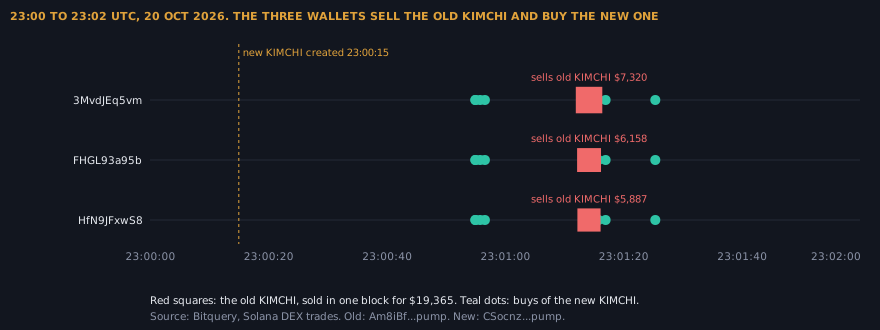
They made a little on the old token and a lot on the new one. They sold the old KIMCHI into the first rush, at about five million dollars of value. Fifteen minutes later it was worth a sixth of that.
| The three wallets, both tokens | Bought / sold |
|---|---|
| Old KIMCHI, 39 buys on 18 October, 06:06 to 06:17 UTC | $17,840 for 5.19 million tokens |
| Old KIMCHI, 3 sells on 20 October, 23:01:14 UTC, one block | $19,365 for the same 5.19 million tokens |
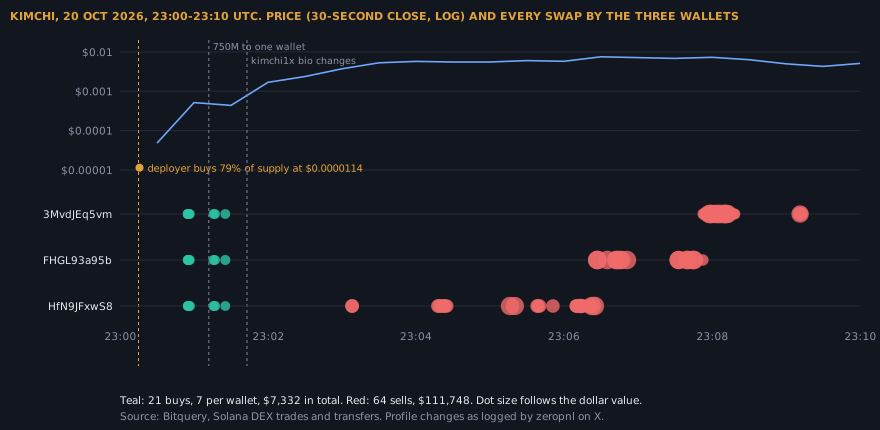
| New KIMCHI, 21 buys, 23:00:55 to 23:01:25 UTC | $7,332, or 68.7 SOL |
| New KIMCHI, 64 sells, by 23:09:12 UTC | $111,748, or 1,048.8 SOL |
| Net across both tokens | about $105,900 |
03 · Nine minutesSeven rounds in, sixty-four sells out
The buys in the new KIMCHI came in seven rounds over thirty seconds. In every round each wallet bought once, for about three SOL. By then the price was already thirty to fifty times what the deployer had paid. The wallets were not first in line. They were early enough.
The selling started less than two minutes after the last buy and was over by nine minutes past. One wallet sold in thirty pieces, one in nineteen, one in fifteen. Each came away with between thirty-three and thirty-six thousand dollars.
| New KIMCHI, by wallet | Bought / sold / last sell |
|---|---|
| 3MvdJEq5vmCPemsufvg6yEGCNzFFs2Aypp4uWEY1bBW1 | $2,465 / $35,426 / 23:09:12 |
| FHGL93a95byonJbk8PzZFhCNuxDwgqRwUXcUkdkfeMNA | $2,433 / $38,238 / 23:07:52 |
| HfN9JFxwS89fERT8of2dt1it6G3P2ia5sJc5J8GkwU5k | $2,434 / $38,084 / 23:06:25 |
Lockstep trades alone could be three copies of the same bot. The ledger says more than that.
04 · The linksThree wallets, one purse
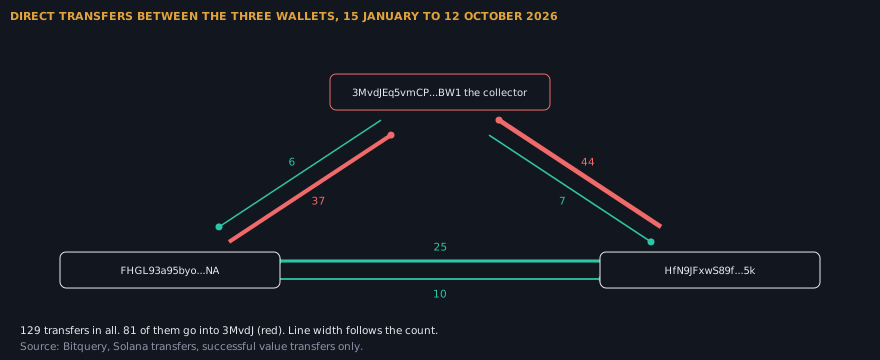
The three wallets pay each other. Since 15 January they have made 129 direct transfers between them, in SOL and in tokens. Most go one way: 81 of them end in 3MvdJEq5vmCPemsufvg6yEGCNzFFs2Aypp4uWEY1bBW1. In twenty-six different blocks, the other two both sent to it in the same block. That is one collector and two feeders, run together.
| Direct transfers, 15 January to 12 October 2026 | Count / SOL moved |
|---|---|
| HfN9JF to 3MvdJ | 44 / 52.7 SOL |
| FHGL93 to 3MvdJ | 37 / tokens only |
| HfN9JF to FHGL93 | 25 / 247.5 SOL |
| FHGL93 to HfN9JF | 10 / 134.3 SOL |
| 3MvdJ to HfN9JF | 7 / 190.2 SOL |
| 3MvdJ to FHGL93 | 6 / 63.2 SOL |
KIMCHI is one trade among many for them. In the three days before the vlog the wallets traded about a hundred different tokens. We found no transfer in either direction between them and the new KIMCHI's deployer. We found none with the old KIMCHI's creator either, or with the wallet that got 75% of the new supply. You can check the wallets yourself with the Solana DEX API or trace them in the Bitquery MCP.
05 · BeforeThey had met this deployer before
The deployer of the new KIMCHI, EFSr396A6Jh7bNCSujGRLMkyXspbWitEvjNVatGD56oF, has launched more than thirty tokens on pump.fun since late July. Two of those launches had the same visitors.
On the last day of July the deployer created a token. Two seconds later, in one block, FHGL93 and HfN9JF both received tokens from its bonding curve. Within a minute FHGL93 began moving its share to the collector. A week later it happened again. Same two-second gap, same block for both, and both sent their tokens on to the collector in one block two minutes later.
| The deployer's earlier launches | What the two feeder wallets did |
|---|---|
| 4JF6AaU6ShrTo5oRwdYLZv89pVwQpjgtTbYRtrjFpump, created 31 July 2026, 03:11:02 UTC | Both received tokens at 03:11:04 in block 436277371; FHGL93 sent its share to 3MvdJ at 03:11:41 |
| 4hwoWqnvResD3MH4sxJ3EA2p23AB6nqmQmLed7sEpump, created 6 August 2026, 21:25:57 UTC | Both received tokens at 21:25:59 in block 437659708; both sent to 3MvdJ at 21:28:03 in block 437660003 |
A two-second entry is fast, and fast bots snipe many launches. What stands out is the overlap. The same wallets were early into this deployer's tokens in July and August, and in October they held the token it copied.
06 · The launchNo curve for anyone else
Most pump.fun tokens start on a bonding curve. Buyers push the price up step by step until the curve fills, and then the token moves to a pool on PumpSwap. The new KIMCHI skipped that. The deployer's launch transaction bought 793 million of the billion tokens for 85 SOL. That filled the curve in one go.
So the first price anyone else could get was 3.8 times the deployer's. Fifty-seven seconds after launch, the deployer sent 750 million of its tokens to a single wallet that has never sold. That wallet has been widely flagged on X as Kimchi's. The deployer sold most of the rest by 23:16. Its own profit on KIMCHI was about twenty-six thousand dollars.
| The new KIMCHI's launch | Record |
|---|---|
| Deployer's first buy, inside the launch transaction | 793,086,976 tokens for 85 SOL, $9,073, at $0.0000114 |
| First outside buyer's price, same second | $0.0000439 |
| Sent to Gs5FHwYLrDBmCmiv5VhBLCvyiBmBYfcPedZDqR88GYeX, 23:01:12 UTC | 750,000,000 tokens, 75% of supply |
| Deployer's KIMCHI trades, 23:00 to 02:20 UTC | $11,435 bought / $37,184 sold |
07 · The rehearsalFour one-dollar launches first
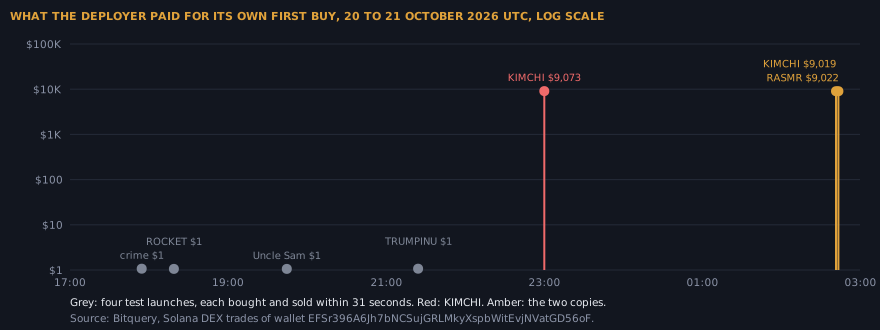
The deployer did not start with KIMCHI that evening. At 17:54 UTC it launched a token called crime. It bought a dollar's worth and sold it fifteen seconds later. It did the same with ROCKET at 18:18, Uncle Sam at 19:44 and TRUMPINU at 21:24. Each test was bought and sold within thirty-one seconds.
Then came KIMCHI, with a first buy more than eight thousand times larger. Less than four hours after that, the deployer ran the same move twice more. A second KIMCHI at 02:41 and a token named RASMR at 02:43 each opened with an 85 SOL curve-filling buy. Both were sold off within eighteen seconds.
08 · Who took itWhere the first-hour money went
The ledger shows who took the first hour's money. The deployer made tens of thousands. The 75% wallet holds a paper fortune it has not touched. The cash went to the fastest traders, and the three wallets here are the clearest group among them.
They are also the group with the best seat. They held the token being vamped, and they left it within a minute of its copy appearing. We cannot see why they moved when they did. The ledger shows that they did, together, and that they have done this deployer's launches before. For other launch traces see our pieces on pump.fun Mayhem Mode and a deployer's funding trail, and the pump.fun API behind them.
Trade figures are Solana DEX swaps from Bitquery's trade data, each valued at the lower of its two priced sides. For every trade in this piece that is the SOL side. Times are block times in UTC. Trade history in this dataset reaches back about 30 days, so the old KIMCHI's July launch and the deployer's July and August launches are described from transfer and mint records, not trades.
The three wallets are grouped by direct transfers between them, shared blocks and trades placed at the same instant. That shows common control or coordination; it does not show who controls them. The count of about a hundred tokens covers all 1,073 of their trades from 18 October to 23:00 UTC on 20 October.
The profile changes at 23:00 UTC, pump.fun's avatar and banner and kimchi1x's bio, come from timestamps posted on X by zeropnl and are not on-chain. Whether the wallet that received 75% of the new supply belongs to Kimchi is a public claim we did not verify.
09 · The recordAddresses behind this story
FAQ
What is a vamp on pump.fun?
A vamp is a new token launched with the same name and ticker as one that already trades, timed so that buyers and attention move to the copy. Here the copy launched as Kimchi's vlog went live, and the old KIMCHI lost most of its value within fifteen minutes.
Who profited from the new KIMCHI's first minutes?
Mostly fast traders. Three linked wallets bought $7,332 of it in the first minute and a half and sold it for $111,748 by 23:09 UTC. The deployer made about $26,000 from its own trades.
Did the three wallets know the new KIMCHI was coming?
The ledger cannot show what anyone knew. It shows that they held the old KIMCHI, sold all of it 59 seconds after the copy was created, and were buying the copy at the same time. Two of them also entered this deployer's launches in July and August two seconds after creation.
Are the three wallets connected to the deployer?
We found no direct transfer between them and the deployer, the old token's creator, or the wallet that received 75% of the new supply. They are connected to each other by 129 transfers since January.
How was this traced?
With Bitquery's Solana trade and transfer data. We listed the first buyers and biggest sellers of the new KIMCHI, then followed their transfers to each other and their earlier trades, including in the old KIMCHI.
This article is provided for informational and educational purposes only and reflects analysis of publicly available on-chain data as of the dates indicated. It does not constitute legal, financial, compliance, or investment advice, and nothing in it is a recommendation to buy, sell, or hold any token or asset.
The findings describe swaps, transfers and token mints observed in Solana data between January and 21 October 2026, together with the rules used to value them and to group wallets. The grouping of the three wallets is an inference from direct transfers, shared blocks and simultaneous trades. Solana addresses are pseudonymous; each wallet here is described by its behaviour and attributed to nobody. The record shows where tokens and value moved, and not who knew what or why.
References to Kimchi, pump.fun, zeropnl or any other named person or project describe public posts and on-chain records, and are not statements about any person's conduct, knowledge or intentions. Off-chain timestamps are reported as they were posted by third parties. Newly launched memecoins carry a high risk of total loss.
Nothing herein should be relied upon as a definitive determination of fact. Readers should conduct their own independent verification before taking any action. The authors and publisher accept no liability for any loss or damage arising from reliance on this material. All trademarks and company names are the property of their respective owners.
Reported by Divyasshree for Bitquery Research, with AI tools; every figure was checked against the raw data.
See who was first into a launch, and what they held before
The figures above come from Bitquery's Solana data: every pump.fun and PumpSwap trade, and every transfer between the wallets. The PumpSwap API gives you the trades, and the Bitquery MCP is how the wallets and their links were traced.