Birdeye to Bitquery Migration Guide
We mapped 75 Birdeye API endpoints to Bitquery GraphQL queries and ran each on the live API. See every result, the tested queries and the gaps.
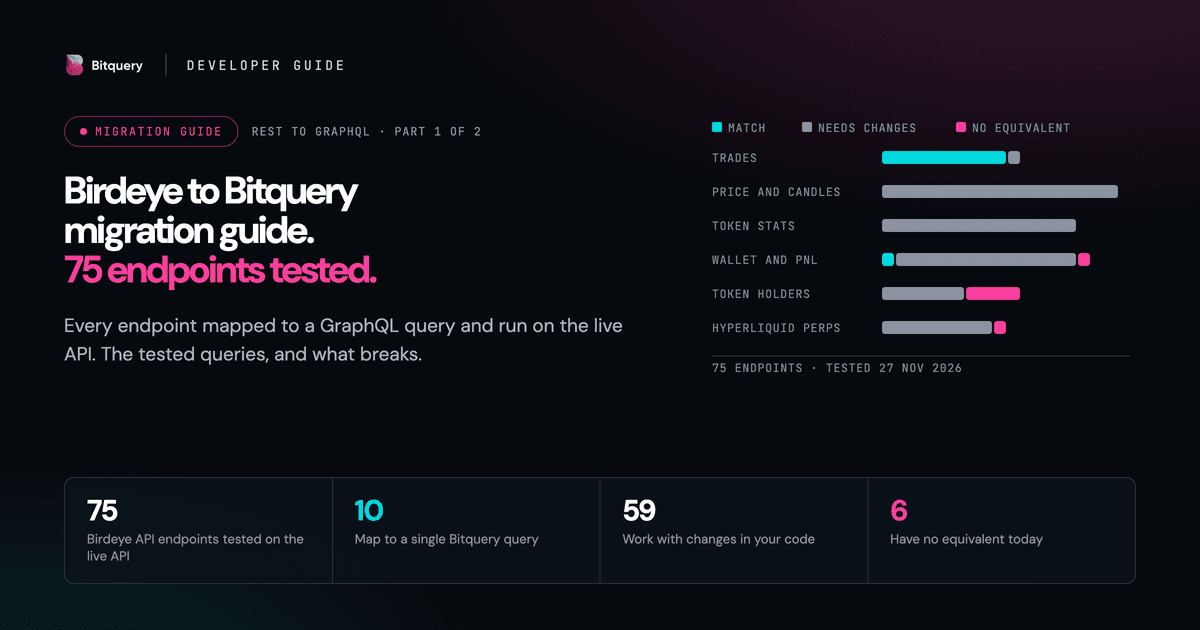
You can move from the Birdeye API to Bitquery, but every call changes. We took the 75 endpoints in Birdeye's six largest API groups and wrote a Bitquery GraphQL query for each. Then we ran every query on the production API on 27 November 2026.
Ten Birdeye endpoints map to a single Bitquery query with the same data. Fifty-nine map with changes. Six have no equivalent today.
If you ship on Birdeye, the tables show what a move to Bitquery costs in code, and where Birdeye does more. For a product-level view, read our Bitquery vs Birdeye comparison.
Key findings
- Trades are the closest fit. Nine of the 10 trade endpoints map to a single query. Each row carries the wallet, the transaction, the DEX, the pool, both token amounts and a USD value.
- Prices and candles all need changes. All 17 endpoints work, and none is a like-for-like swap. Candles run from 1 second to 1 hour, with no daily, weekly or monthly bars.
- Wallet PnL is math in your code. Bitquery returns what a wallet bought and sold per token, and your code works out realized and unrealized PnL. History reaches 30 days.
- Bitquery has no Solana top-holder list. Holder lists and exact holder counts work on EVM chains. On Solana, they do not.
- A single request can price tokens on different chains. We asked for a Solana token and an Ethereum token in the same call and got both prices back. Birdeye takes one chain per request.
Birdeye API endpoints mapped to Bitquery, by group
Of the 75 Birdeye API endpoints we tested, 10 match a single Bitquery query, 59 need changes and 6 have no equivalent.
| Group | Endpoints | Match | Needs changes | No equivalent |
|---|---|---|---|---|
| Trades | 10 | 9 | 1 | 0 |
| Price and candles | 17 | 0 | 17 | 0 |
| Token stats and market data | 14 | 0 | 14 | 0 |
| Wallet, portfolio and PnL | 15 | 1 | 13 | 1 |
| Token holders | 10 | 0 | 6 | 4 |
| Hyperliquid perpetual futures (perps) | 9 | 0 | 8 | 1 |
| Total | 75 | 10 | 59 | 6 |
"Match" means a single Bitquery query returned the same information. "Needs changes" means the data is there in a different shape: two queries, math in your code, fewer fields or shorter history. "No equivalent" means we found no query that answers the endpoint.
Birdeye documents 113 REST endpoints and 11 WebSocket stream types. Part 2 of this guide covers the other 38 endpoints and the streams. Until Part 2 is out, treat those as not yet mapped.
How the Birdeye API and the Bitquery API differ
The Birdeye API is REST. Each endpoint gives a fixed answer to a fixed question. Bitquery is GraphQL, so you pick the fields, the filters and the sums inside the query.
That difference explains most of the table. Where Birdeye hands you a ready number, such as a 24-hour price change, Bitquery hands you the two prices and you subtract. In return, you can add fields and filters that a fixed endpoint lacks. A USD size filter works on any trade query, for example.
Bitquery calls each dataset a cube, so DEXTrades is the cube of DEX trades. Cubes sit under roots. The Solana and EVM roots hold chain data such as trades and holders. The Trading root holds prices, candles and wallet trade totals across chains for the last 30 days.
Every query below goes to https://streaming.bitquery.io/graphql with a bearer token. That endpoint is the v2 API. A few Solana wallet lookups use the older v1 endpoint, https://graphql.bitquery.io, and we flag each one.
Run your first Bitquery query
Create an account at account.bitquery.io and copy your access token. Save the token in an environment variable named BITQUERY_TOKEN. Then send the query as a POST body. This call asks for the newest BONK trade on Solana:
curl -s https://streaming.bitquery.io/graphql \
  -H "Content-Type: application/json" \
  -H "Authorization: Bearer $BITQUERY_TOKEN" \
  -d '{"query":"{ Solana { DEXTradeByTokens(limit: {count: 1}, orderBy: {descending: Block_Time}, where: {Trade: {Currency: {MintAddress: {is: \"DezXAZ8z7PnrnRJjz3wXBoRgixCa6xjnB7YaB1pPB263\"}}}, Transaction: {Result: {Success: true}}}) { Block { Time } Transaction { Signature Signer } Trade { Amount AmountInUSD PriceInUSD Dex { ProtocolName } Market { MarketAddress } Side { Type } } } } }"}'
At 15:02 UTC, the call came back in 0.54 seconds with this row:
{
  "data": {
    "Solana": {
      "DEXTradeByTokens": [
        {
          "Block": { "Time": "2026-11-27T15:02:02Z" },
          "Transaction": {
            "Signature": "47AmSaktqY3LuF4ZVDFPqbC6V8thPYikispQzjHJCrXAb9YvGMBx5jxM9kUsdbdisrATgSqnqRbXuSLrDAUmgzA5",
            "Signer": "9f6tZHnM7VdTktMEzDraixQRjjbvt36FfghDtwtn3toD"
          },
          "Trade": {
            "Amount": "557524.49225",
            "AmountInUSD": "1.173868",
            "PriceInUSD": 0.000002111768380186491,
            "Dex": { "ProtocolName": "scorch" },
            "Market": { "MarketAddress": "5ZWCKP2E8LqTUmo98xhq1YELjcqvxpNsv4xfzVbKGswc" },
            "Side": { "Type": "sell" }
          }
        }
      ]
    }
  }
}
Check two things in every response:
- Read
errorsbeforedata. A bad query still returns HTTP 200. We sent a query with a wrong field name and got status 200 with the message in theerrorsarray. - Parse amounts as strings.
AmountandAmountInUSDarrive as strings, so a large value keeps its precision.PriceInUSDarrives as a number.
To try a query without code, paste it into the Bitquery IDE.
Trades: 9 of 10 match
Trades are the easiest part of a move. Bitquery's DEX API and Solana DEX API cover the same swaps that Birdeye's trade endpoints return.
GET /defi/txs/token returns the trades of a token. This Bitquery query returned 5 BONK trades at 14:20 UTC:
{
  Solana {
    DEXTradeByTokens(
      limit: {count: 5}
      orderBy: {descending: Block_Time}
      where: {Trade: {Currency: {MintAddress: {is: "DezXAZ8z7PnrnRJjz3wXBoRgixCa6xjnB7YaB1pPB263"}}}, Transaction: {Result: {Success: true}}}
    ) {
      Block { Time Slot }
      Transaction { Signature Signer Index }
      Instruction { Index }
      Trade {
        Currency { Symbol MintAddress Decimals }
        Amount AmountInUSD Price PriceInUSD
        Account { Owner Address }
        Dex { ProtocolName ProtocolFamily ProgramAddress }
        Market { MarketAddress }
        Side { Type Amount AmountInUSD Currency { Symbol MintAddress } Account { Address } }
      }
    }
  }
}
Each row names the wallet that signed the swap, the pool, the DEX and both sides in USD. That is enough to build a trade feed, a whale alert or a copy-trading signal.
If your parser reads Birdeye's v3 trade rows, rename the fields like this on Solana:
| Birdeye field | Bitquery field |
|---|---|
tx_hash | Transaction.Signature |
block_unix_time | Block.Time, an ISO 8601 string |
block_number | Block.Slot |
owner | Transaction.Signer |
pool_id | Trade.Market.MarketAddress |
source | Trade.Dex.ProtocolName |
volume_usd | Trade.AmountInUSD |
GET /defi/v3/token/txs-by-volume filters trades by size, which is how you catch whale buys. Add a USD range and a DEX filter to the same query:
where: {Trade: {Currency: {MintAddress: {is: "So11111111111111111111111111111111111111112"}}, AmountInUSD: {ge: "10000", le: "50000"}, Dex: {ProtocolFamily: {is: "Raydium"}}}, Transaction: {Result: {Success: true}}}
The filter returned WSOL trades between $10,000 and $50,000 on Raydium. Birdeye offers this endpoint on Solana only. On Ethereum, a $1,000 floor ran under the EVM root, with SmartContract in place of MintAddress.
| Birdeye endpoint | Status | How it maps |
|---|---|---|
GET /defi/txs/pair | Match | DEXTrades filtered by pool address |
GET /defi/txs/pair/seek_by_time | Match | Add a time window |
GET /defi/txs/token | Match | DEXTradeByTokens filtered by token |
GET /defi/txs/token/seek_by_time | Needs changes | Older Solana windows use the archive, which has a different shape |
GET /defi/v3/token/txs | Match | Same query with owner, pool or source filters |
GET /defi/v3/token/txs-by-volume | Match | USD size filter |
GET /defi/v3/token/mint-burn-txs | Match | TokenSupplyUpdates; the sign tells mint from burn |
GET /defi/v3/txs | Match | DEXTrades with a protocol filter |
GET /defi/v3/txs/recent | Match | Same query, newest first |
GET /trader/txs/seek_by_time | Match | DEXTrades filtered by Transaction.Signer |
What breaks in trades
- LP adds and removes are a second query. Birdeye returns them with trades when you ask for all types. On Bitquery, swaps and liquidity events sit in different cubes, and you merge them by time.
- Use the signer as the trader. The per-side account fields often hold the pool. On Solana, use
Transaction.Signer. On EVM, useTransaction.From. - A query with no token filter returns each swap twice.
DEXTradeByTokenshas a row per token, so a SOL to BONK swap shows up once for each token. For a wallet-wide or chain-wide list, useDEXTrades. - DEX names differ. Bitquery's
amm_v3is Birdeye'sraydium_clamm. Build a DEX name mapping before you compare sources. - Old Solana trades use another shape.
DEXTradeByTokenscovers about the last 8 hours on Solana. For older trades, queryDEXTradesunderSolana(dataset: archive)with aBlock.Timewindow. The archive splits each row into a buy side and a sell side. Our archive queries returned Solana trades from January 2025 and Ethereum trades from January 2023.
Token prices and OHLCV candles: all 17 need changes
Prices are where you write the most new code. The Crypto Price API builds a USD price for each token from DEX trades, and every Birdeye price endpoint we tested maps to it. It works as a Solana token price API, and the same query covers EVM chains. No endpoint maps one-to-one, though.
GET /defi/price returns a USD price and a 24-hour change. On Bitquery, that is two aliases in a single request, now and ago24h:
{
  Trading {
    now: Tokens(
      where: {Token: {Did: {is: ""}, Network: {is: "Solana"}, Address: {is: "DezXAZ8z7PnrnRJjz3wXBoRgixCa6xjnB7YaB1pPB263"}}, Interval: {Time: {Duration: {eq: 1}}}}
      orderBy: {descending: Block_Time}
      limit: {count: 1}
    ) { Block { Time } Price { IsQuotedInUsd Ohlc { Close } } Liquidity { Usd } }
    ago24h: Tokens(
      where: {Token: {Did: {is: ""}, Network: {is: "Solana"}, Address: {is: "DezXAZ8z7PnrnRJjz3wXBoRgixCa6xjnB7YaB1pPB263"}}, Interval: {Time: {Duration: {eq: 60}}}, Block: {Time: {till_relative: {hours_ago: 24}}}}
      orderBy: {descending: Block_Time}
      limit: {count: 1}
    ) { Block { Time } Price { Ohlc { Close } } }
    eth_now: Tokens(
      where: {Token: {Did: {is: ""}, Network: {is: "Ethereum"}, Address: {is: "0xc02aaa39b223fe8d0a0e5c4f27ead9083c756cc2"}}, Interval: {Time: {Duration: {eq: 1}}}}
      orderBy: {descending: Block_Time}
      limit: {count: 1}
    ) { Block { Time } Price { Ohlc { Close } } Liquidity { Usd } }
  }
}
At 14:23 UTC, this returned BONK at $0.0000021945, the BONK price 24 hours earlier, and WETH on Ethereum at $1,721.07. The third alias is there to show two chains in the same request.
GET /defi/ohlcv returns candles for a chart. This query returned six 5-minute BONK candles, each with a market cap:
{
  Trading {
    Tokens(
      where: {Token: {Did: {is: ""}, Network: {is: "Solana"}, Address: {is: "DezXAZ8z7PnrnRJjz3wXBoRgixCa6xjnB7YaB1pPB263"}}, Interval: {Time: {Duration: {eq: 300}, Start: {since: "2026-11-27T12:00:00Z", till: "2026-11-27T12:29:59Z"}}}}
      orderBy: {ascending: Interval_Time_Start}
      limitBy: {by: Interval_Time_Start, count: 1}
      limit: {count: 10}
    ) {
      Interval { Time { Start Duration } }
      Price { IsQuotedInUsd Ohlc { Open High Low Close } }
      Volume { Base Usd }
      Supply { MarketCap TotalSupply }
    }
  }
}
If you chart with TradingView, the TradingView data feed wraps the same candles.
| Birdeye endpoint | Status | How it maps |
|---|---|---|
GET /defi/price | Needs changes | Trading.Tokens. The 24-hour change is a second alias. USD only. |
GET /defi/multi_price | Needs changes | A token list across chains in a single call. No 24-hour change in the row. |
POST /defi/multi_price | Needs changes | Same query as the GET form. |
GET /defi/history_price | Needs changes | Candles from 1 second to 1 hour. A quiet period has no candle. 30 days. |
GET /defi/historical_price_unix | Needs changes | 30 days of index price. For older dates, the Solana archive gives a single trade's price. |
GET /defi/ohlcv | Needs changes | USD only. No 3-minute candle and none above 1 hour. Volume counts the base side. |
GET /defi/ohlcv/pair | Needs changes | Trading.Pairs. 30 days. Ethereum pools use a different key field. |
GET /defi/ohlcv/base_quote | Needs changes | A candle per pool. Your code merges the pools. |
GET /defi/v3/ohlcv | Needs changes | 1-second and 30-second candles work. 15-second candles do not. No padding option. |
GET /defi/v3/ohlcv/pair | Needs changes | Same gaps as the token form. |
GET /defi/price_volume/single | Needs changes | Both percent changes are math in your code. Windows snap to whole hours. |
POST /defi/price_volume/multi | Needs changes | Same as the single form with a token list. |
GET /defi/v3/liquidity/history/token | Needs changes | USD liquidity only. No exit or stable liquidity. |
GET /defi/v3/liquidity/history/pair | Needs changes | USD liquidity counts the quote side only. The row includes both reserves. |
POST /defi/v3/liquidity/latest/token | Needs changes | Price and liquidity per token. No exit or stable liquidity. |
GET /defi/v3/liquidity/ohlc/pair | Needs changes | No liquidity candle field. Build high and low from a quantile, with an alias per candle. |
GET /defi/v3/liquidity/ohlc/token | Needs changes | Same as the pair form. |
What breaks in prices
- Candle intervals stop at 1 hour. You get ten intervals. In seconds: 1, 3, 5, 10 and 30. In minutes: 1, 5, 15 and 30. The last is 1 hour. Roll up 4-hour, daily and weekly candles in your code.
- A quiet period has no candle. BONK returned 8 one-second candles for a 60-second window. Fill the gaps before you draw the chart.
- Prices are in USD.
Trading.Tokenshas no price in SOL or ETH. - Keep
Did: {is: ""}in the filter. The emptyDidselects the per-token row. Rows with adid:value are asset-level copies. Durationis in seconds. A 5-minute candle isDuration: {eq: 300}.- Volume counts the base side. In a 1-hour WSOL test, the token row showed $7.14M. Pairs with WSOL as the quote held $82.8M more.
- History is 30 days. Token and pool candles both started on 28 October 2026 in our test. The API has no older candles.
- Pool liquidity in USD counts the quote side. An Ethereum WETH/USDC pool showed $7.93M and left out about $51.6M of WETH. Read the reserves and price them yourself.
Token stats and market data: all 14 need changes
All 14 Birdeye token stats endpoints map to Bitquery with changes. Birdeye's GET /defi/token_overview returns the whole snapshot in a single call. On Bitquery, you build the same snapshot from two cubes in a single request. Trading.Tokens gives price, supply, market cap and liquidity. DEXTradeByTokens gives trade counts, buyers, sellers and volume.
This query builds a 1-hour BONK snapshot:
{
  Trading {
    Tokens(
      where: {Token: {Did: {is: ""}, Network: {is: "Solana"}, Address: {is: "DezXAZ8z7PnrnRJjz3wXBoRgixCa6xjnB7YaB1pPB263"}}, Interval: {Time: {Duration: {eq: 60}}}}
      orderBy: {descending: Block_Time}
      limit: {count: 1}
    ) {
      Block { Time }
      Price { Ohlc { Close } }
      Supply { TotalSupply CirculatingSupply MarketCap FullyDilutedValuationUsd }
      Liquidity { Usd }
    }
  }
  Solana {
    DEXTradeByTokens(
      where: {Trade: {Currency: {MintAddress: {is: "DezXAZ8z7PnrnRJjz3wXBoRgixCa6xjnB7YaB1pPB263"}}, PriceAsymmetry: {lt: 0.1}}, Block: {Time: {since_relative: {hours_ago: 1}}}, Transaction: {Result: {Success: true}}}
    ) {
      Trade { Currency { Symbol Name Decimals } }
      markets_1h: uniq(of: Trade_Market_MarketAddress)
      trades_1h: count
      buys_1h: count(if: {Trade: {Side: {Type: {is: buy}}}})
      sells_1h: count(if: {Trade: {Side: {Type: {is: sell}}}})
      volume_1h_usd: sum(of: Trade_AmountInUSD)
      wallets_1h: uniq(of: Trade_Account_Owner)
    }
  }
}
At 15:07 UTC, the query returned a BONK market cap of $184.9M and liquidity of $665,484. The last hour had 3,542 trades on 162 pools. Buys were 1,760 and sells were 1,782, from 247 wallets. Volume was $85,252.
Bitquery returns these fields:
- price, market cap and fully diluted valuation (FDV)
- total and circulating supply
- liquidity in USD
- trade counts, split into buys and sells
- volume and unique wallets
Bitquery does not return a token logo, a website link or social links. It also has no wallet tags such as smart money or whale. Holder count is a separate query through the Token Holder API, and it works on EVM chains only.
Every "multiple" endpoint in this group is its "single" twin with a list of addresses. Change is: to in:. If the query returns rows over time, also add limitBy on the token address.
| Birdeye endpoint | Status | How it maps |
|---|---|---|
GET /defi/token_overview | Needs changes | Two cubes in a single request. No logo or social links. Holder count is a separate query. |
GET /defi/v3/pair/overview/single | Needs changes | Trading.Pairs plus trades by pool. No creation time. Percent change is math in your code. |
GET /defi/v3/pair/overview/multiple | Needs changes | Same query with a list of pools. |
GET /defi/v3/price/stats/single | Needs changes | 24 hours built from hourly candles, so windows align to the hour. |
POST /defi/v3/price/stats/multiple | Needs changes | A token list across Solana and Ethereum worked in a single call. |
GET /defi/v3/token/exit-liquidity | Needs changes | EVM only. A slippage curve per pool, which your code sums. |
GET /defi/v3/token/exit-liquidity/multiple | Needs changes | Same with a token list. Tested on Base. |
GET /defi/v3/token/market-data | Needs changes | Market cap, FDV and supply. Circulating supply read zero for a test token. |
GET /defi/v3/token/market-data/multiple | Needs changes | Same with a token list. |
GET /defi/v3/token/meta-data/single | Needs changes | Name, symbol and decimals only. |
GET /defi/v3/token/meta-data/multiple | Needs changes | Same with a token list. |
GET /defi/v3/token/trade-data/single | Needs changes | Counts and sums cover every field group. On Solana, limits apply past about 8 hours. |
GET /defi/v3/token/trade-data/multiple | Needs changes | A row per token. Tested on Solana and Base. |
POST /defi/v3/token/money-flow | Needs changes | Works for a wallet list you supply. No smart-money or whale tags. |
What breaks in token stats
- Sum the token's own USD field, and filter bad prices. In a 1-hour WSOL window, the counter-side field,
Trade.Side.AmountInUSD, summed to $4.84B. The token's own field,Trade.AmountInUSD, summed to $83.7M withPriceAsymmetry: {lt: 0.1}inside theTradefilter. That matches 1.144M SOL at $73. Use both fixes together. - Percent change is math in your code. Ask for two windows and subtract.
- Circulating supply can read zero. A Base token returned zero in our test. Check the value before you show it.
Wallet, portfolio and PnL: 1 match, 13 need changes, 1 has no equivalent
Bitquery returns what a wallet bought and sold per token, and your code works out the PnL. Birdeye returns realized and unrealized PnL ready-made, which is what wallet trackers and copy-trading apps live on. The Top Traders API and the Wallet Portfolio API pages cover the same data.
This query returned what a wallet bought and sold in two tokens, plus the current prices:
{ Trading {
  pnl: Trades(where:{Trader:{Address:{is:"9f6tZHnM7VdTktMEzDraixQRjjbvt36FfghDtwtn3toD"}},
      Pair:{Token:{Address:{in:["DezXAZ8z7PnrnRJjz3wXBoRgixCa6xjnB7YaB1pPB263","So11111111111111111111111111111111111111112"]}}}}) {
    Pair { Token { Address Symbol Network } }
    buys: count(if:{Side:{is:"Buy"}}) sells: count(if:{Side:{is:"Sell"}})
    boughtQty: sum(of:Amounts_Base, if:{Side:{is:"Buy"}}) soldQty: sum(of:Amounts_Base, if:{Side:{is:"Sell"}})
    investedUsd: sum(of:AmountsInUsd_Base, if:{Side:{is:"Buy"}}) soldUsd: sum(of:AmountsInUsd_Base, if:{Side:{is:"Sell"}})
    Block { first: Time(minimum:Block_Time) last: Time(maximum:Block_Time) } }
  price: Tokens(limit:{count:2}, limitBy:{by:Token_Address, count:1}, orderBy:{descending:Block_Time},
      where:{Interval:{Time:{Duration:{eq:60}}}, Token:{Address:{in:["DezXAZ8z7PnrnRJjz3wXBoRgixCa6xjnB7YaB1pPB263","So11111111111111111111111111111111111111112"]}, Network:{is:"Solana"}}}) {
    Token { Address Symbol } Block { Time } Price { Ohlc { Close } } } } }
For BONK, the test wallet had 889 buys and 902 sells. It put in $1,829.19 and took out $1,671.45. From those totals, your code works out the average cost, the realized PnL and the value of the bag the wallet still holds:
avgCost    = investedUsd / boughtQty
realized   = soldUsd - soldQty * avgCost
unrealized = (boughtQty - soldQty) * (price - avgCost)
If a wallet sold more than it bought in the window, it held tokens from before the window, and the cost of those tokens is unknown.
| Birdeye endpoint | Status | How it maps |
|---|---|---|
GET /v1/wallet/list_supported_chain | Match | The network list in the schema. |
GET /v1/wallet/token_list | Needs changes | On v2, Solana balance updates cover about 8 hours, so idle tokens are missing. |
GET /v1/wallet/tx_list | Needs changes | Solana transfers, which your code groups by signature. |
GET /wallet/v2/current-net-worth | Needs changes | Works on EVM. On Solana, v2 sees the 8-hour window only. |
GET /wallet/v2/leaderboard | No equivalent | Sold minus bought across a wallet is not PnL. |
GET /wallet/v2/net-worth | Needs changes | Solana on v1: received minus sent per token, per date. USD value for the last 30 days only. Slow. |
GET /wallet/v2/net-worth-details | Needs changes | Solana on v1: token totals up to a past date. Your code subtracts and prices them. |
POST /wallet/v2/net-worth-summary/multiple | Needs changes | Solana on v1 with a wallet list. Tested with 2 wallets and a single token. |
GET /wallet/v2/pnl | Needs changes | Trade sums plus the current price. Realized and unrealized PnL are math in your code. 30 days. |
GET /wallet/v2/pnl/chart | Needs changes | Daily volume and trade counts. No realized PnL per point. |
POST /wallet/v2/pnl/details | Needs changes | Per-token rows. The summary block is math in your code. |
GET /wallet/v2/pnl/multiple | Needs changes | Same shape, grouped by trader. Tested on Ethereum. |
GET /wallet/v2/pnl/summary | Needs changes | Counts and volume come ready. Win rate and PnL need the per-token rows. |
GET /wallet/v2/funded-by | Needs changes | Solana on v1: the earliest SOL transfer in. 21 seconds. No funder tags. |
POST /wallet/v2/tx/first-funded | Needs changes | Same v1 query. SOL only: a sort across all tokens returned an error. |
What breaks in wallet data
- PnL history is 30 days. Birdeye offers 90 days and all time.
Trading.Tradescannot see tokens that arrived by transfer. An airdrop has no cost and no buy row.- A token traded as the quote side is not a position. PnL for SOL or USDC reads low. The WSOL row in the query above has this limit.
- Solana balances and first funder use the v1 API. On v2, Solana transfer data covers about 8 hours. On v1, our first-funder query found the wallet's first SOL deposit, dated 4 July 2022. The query took 21 seconds.
- Net worth is math in your code. Subtract what a wallet sent from what it received to get each balance. You can price those balances in USD for the last 30 days.
- You cannot build a PnL leaderboard from a single query. Sold minus bought across a whole wallet is not profit. Our test query put a wallet at $2.62B in a day.
Token holders: 6 need changes, 4 have no equivalent
Holders are the largest gap. Most Birdeye holder endpoints serve Solana. Bitquery has no Solana top-holder list and no Solana holder count today.
On EVM chains, holder data works. This query returned the holder count and the top 5 holders of USDG on Robinhood Chain:
{
  EVM(network: robinhood, dataset: archive) {
    total: Holders(date: "2026-11-26", where: {Currency: {SmartContract: {is: "0x5fc5360d0400a0fd4f2af552add042d716f1d168"}}, Balance: {Amount: {gt: "0"}}}) {
      holders: count(distinct: Holder_Address)
      held: sum(of: Balance_Amount)
    }
    top: Holders(date: "2026-11-26", where: {Currency: {SmartContract: {is: "0x5fc5360d0400a0fd4f2af552add042d716f1d168"}}, Balance: {Amount: {gt: "0"}}}, orderBy: {descendingByField: "Balance_Amount"}, limit: {count: 5}) {
      Holder { Address }
      Balance { Amount }
      Currency { Symbol }
    }
  }
}
The query returned 441,325 USDG holders. On Ethereum, the same cube returned about 66,600 ENS holders. The Holders cube also returns the holder count for a past date. We ran dates in 2024, 2025 and 2026.
| Birdeye endpoint | Status | How it maps |
|---|---|---|
GET /defi/v3/token/holder | Needs changes | EVM Holders on the archive dataset: top list and exact count. No Solana holders. |
GET /holder/v1/distribution | No equivalent | Birdeye serves Solana only. An EVM version works. |
GET /token/v1/chart/tag-holdings | No equivalent | No per-token wallet tags and no Solana balance history. |
GET /token/v1/first-buyers | Needs changes | Two queries. On Solana, it works only for tokens launched in the last 8 hours. |
GET /token/v1/holder-positions | Needs changes | Per-wallet buy and sell volume from trades. Holdings need a second query. |
GET /token/v1/holder-profile | No equivalent | The endpoint is a breakdown by tag, and Bitquery has no such tags. |
POST /token/v1/holder/batch | Needs changes | Solana on v1: received and sent totals for a wallet list. 26 seconds. Your code subtracts. |
GET /token/v1/holder/chart | No equivalent | Birdeye serves Solana only. On EVM, daily points work. |
GET /token/v1/wallet-tags-tracker | Needs changes | You can build a sniper group from early buyers. Dev and smart-trader tags have no source. |
GET /token/v1/wallet-tags-tracker/details | Needs changes | Same query, grouped by wallet. |
What breaks in holders
- Use the archive dataset. On the default dataset, the holder cube counts only addresses that changed in about the last 9 days.
- Bitquery has no per-token wallet tags. Birdeye tags holders as sniper, insider, dev or smart trader, and five of its endpoints use those tags. Bitquery's Address Labels API names entities such as exchange wallets. It does not tag snipers or insiders per token.
- Very large tokens can time out. Our archive holder query for USDC on Ethereum did not return in 90 seconds.
Hyperliquid perps: 8 need changes, 1 has no equivalent
Eight of Birdeye's 9 Hyperliquid perps endpoints map to Bitquery with changes, and the liquidation map has no equivalent. Bitquery's Hyperliquid API has a Hyperliquid root with trades, funding payments and liquidations. It also snapshots every account's open positions about every 12 minutes.
Reading positions takes two steps. First, ask for the newest snapshot:
{
  Hyperliquid {
    Snapshots(limit: {count: 1}, orderBy: {descending: Block_Time}) {
      Block { Number Time }
      IsComplete
    }
  }
}
Check that IsComplete is true. Then pass that block number to the position query, with a since time a few minutes before the snapshot's Block.Time. With the 14:11 UTC snapshot, this query returned the five largest open BTC positions:
{
  Hyperliquid {
    SnapshotPositions(
      limit: {count: 5}
      orderBy: {descendingByField: "pv"}
      where: {Block: {Number: {eq: "1236760000"}, Time: {since: "2026-11-27T14:00:00Z"}}, Market: {CoinRaw: {is: "BTC"}}}
    ) {
      Trader { Address }
      IsVault
      Position { Side Size EntryPrice Leverage IsCross }
      Margin { MarginUsed MaintenanceMargin }
      Valuation { MarkPx PositionValue UnrealizedPnl EntryNotional }
      CumFunding { SinceOpen SinceChange AllTime }
      Market { MaxLeverage }
      pv: calculate(expression: "$Valuation_PositionValue")
    }
  }
}
| Birdeye endpoint | Status | How it maps |
|---|---|---|
GET /perps/v1/token/list | Needs changes | Market snapshot plus positions grouped by side. No time-frame option. |
GET /perps/v1/token/overview | Needs changes | Price, open interest, position count and liquidations. Liquidations are in coin size. |
GET /perps/v1/token/open_positions | Needs changes | The position snapshot has most fields. No liquidation price or open time. |
GET /perps/v1/token/liquidation_map | No equivalent | No liquidation price field in any cube. |
GET /perps/v1/wallet/list | Needs changes | Equity ranking from snapshots. PnL and volume from trades. 30 days. |
GET /perps/v1/wallet/overview | Needs changes | Account snapshot plus trade and funding sums. 30 days. |
GET /perps/v1/wallet/open_positions | Needs changes | Snapshot with a 12-minute lag. No liquidation price. |
POST /perps/v1/wallet/trade_fills | Needs changes | Every Birdeye field maps. History is 30 days. |
POST /perps/v1/wallet/transfers | Needs changes | Raw signed actions. About 7 days. A 7-day wallet query timed out. |
What breaks in perps
- The API has no liquidation price field.
GET /perps/v1/token/liquidation_maphas no equivalent. For an account with a single cross position, you can estimate a liquidation price from the margin fields. The estimate is rough because it skips Hyperliquid's exact formula. - History is 30 days. The earliest fill we found is from 28 October 2026. Position snapshots reach back about 7 days.
- A snapshot query needs the block number and a time filter. Replace the block number with the newest one from the first query. Without the time filter, an older snapshot returns zero rows. We hit this ourselves: the same query returned 37,727 BTC positions with the filter and none without it.
- Always set a time filter on trades. A query with no time filter saw about 24 hours. For a test wallet, it counted 4,814 fills. With a start date, it counted 82,329.
- Filter by the raw coin name.
Symbol: "BTC"also matches other markets with BTC in the name. UseCoinRaw.
How to migrate from the Birdeye API to Bitquery
Move one group at a time, starting with the closest fit:
- List your endpoints. Search your code for Birdeye paths and look up each one in the tables above.
- Move trade feeds first. Nine of 10 trade endpoints map to a single query, so this step is mostly field renames.
- Move prices and candles. Add a roll-up for candles above 1 hour, and fill the gaps for quiet periods.
- Move wallet PnL. Write the realized and unrealized PnL math once, and reuse it for every wallet.
- Keep Birdeye where Bitquery has no equivalent. That covers Solana top holders, holder distribution and holder charts. It also covers sniper and insider tags, the wallet PnL leaderboard and the Hyperliquid liquidation map.
- Run both APIs side by side. Compare the numbers for a week before you switch off the old calls.
Birdeye API pricing vs Bitquery pricing
Birdeye bills compute units. Bitquery bills API points. The two units do not convert, so run your own workload on each service and compare the bills.
| Birdeye | Bitquery | |
|---|---|---|
| Entry paid plan | Lite, $39 per month, 2.5M compute units | Personal, $49 per month, 100,000 API points |
| Middle plan | Starter, $99 per month, 8M compute units | Pro, $99 per month, 1M API points and streams |
| Larger plan | Premium, $199 per month, 20M compute units | Scale, $299 per month, 5M API points |
| Free tier | Standard, 30,000 compute units | 7-day trial, 1,000 API points |
We took the Birdeye prices from Birdeye's pricing docs on 27 November 2026, and the Bitquery prices from the Bitquery pricing page on the same day. We have not run the same workload on both services yet. Part 2 will run one workload on both and compare the bills.
Limits: chains, history and streams
Birdeye covers more chains, and the Bitquery API serves 30 days of history.
- Chains. Birdeye lists 17 chains, including Sui, Aptos, Monad, zkSync, Mantle and HyperEVM. Bitquery's self-service plans cover 10 core chains: Solana, Ethereum, Tron, Base, Arbitrum, Optimism, BNB Chain, Polygon, Robinhood Chain and Arc. If you need Sui or Aptos, Birdeye is the better choice.
- History. The API serves 30 days of prices, candles and wallet PnL. For years of trades as files, the Bitquery Data Store sells Solana DEX trades as Parquet.
- Streams. We tested HTTP request-response queries only. Bitquery also pushes the same data over WebSocket and gRPC streams, which Part 2 maps to Birdeye's WebSocket API.
- Scope. This part covers 75 of Birdeye's 113 REST endpoints. Part 2 covers search, token lists, trending tokens, security checks and streams.
How we tested
We picked the six largest groups in Birdeye's docs, 75 endpoints in total. For 69 endpoints, we read Birdeye's reference page. For the other six, all price endpoints, we worked from Birdeye's docs index. In each case, we wrote the Bitquery query that answers the same question. Then we ran it on the production API with a normal customer API key.
An endpoint counts as "match" or "needs changes" only if its query came back with data and no errors. We ran the tests on 27 November 2026 with well-known tokens. On Solana, we used BONK and WSOL. On Ethereum, we used WETH, USDC and ENS. We also used USDG on Robinhood Chain and the BTC market on Hyperliquid. A few tests used other tokens: USDC on Solana, a Pump.fun token launched that day, and AERO and VIRTUAL on Base.
We did not call the Birdeye API, so we did not compare Birdeye's numbers with ours. We tested most endpoints on Solana and on a single EVM chain.
We used AI tools to write and run the test queries, and we checked each result against the production API.
FAQ
What is the Birdeye API?
The Birdeye API is a REST API for on-chain trading data. Its docs list 113 REST endpoints and 11 WebSocket stream types across 17 chains. It serves token prices, candles, trades, wallet PnL, holders and Hyperliquid perps data.
Is Bitquery a drop-in replacement for the Birdeye API?
No. The Birdeye API is REST and Bitquery is GraphQL, so every call changes. Of the 75 endpoints we tested, 10 map to a single Bitquery query with the same data, 59 need changes and 6 have no equivalent. Trades move with field renames. Solana top holders and per-token wallet tags do not move at all.
Which Birdeye API endpoints map most cleanly?
The Birdeye API trade endpoints map most cleanly. Nine of 10 map to a single Bitquery query, and each row has the wallet, transaction, DEX, pool, amounts and USD value.
Does Bitquery have a Solana token holder list?
Bitquery has no Solana token holder list today. Bitquery holder lists and exact holder counts work on EVM chains, including Ethereum and Robinhood Chain.
Does Bitquery return wallet PnL?
Bitquery returns what a wallet bought and sold per token for the last 30 days. Your code works out realized and unrealized PnL from those totals.
How far back does Bitquery price history go?
Bitquery price history goes back 30 days on the API, with candles from 1 second to 1 hour.
How does Birdeye API pricing compare with Bitquery pricing?
Birdeye's paid plans start at $39 per month for 2.5M compute units. Bitquery's start at $49 per month for 100,000 API points. The units differ, so test your own workload on both.
How do I start a move from the Birdeye API to Bitquery?
Create an account at account.bitquery.io, copy your access token and paste a Solana DEX trade query into the Bitquery IDE. If you build with an AI agent, the Bitquery MCP server exposes the same data as tools.
Related reading
Subscribe to our newsletter
Subscribe and never miss any updates related to our APIs, new developments & latest news etc. Our newsletter is sent once a week on Monday.