Tokenized money market funds: what Wall Street put on-chain
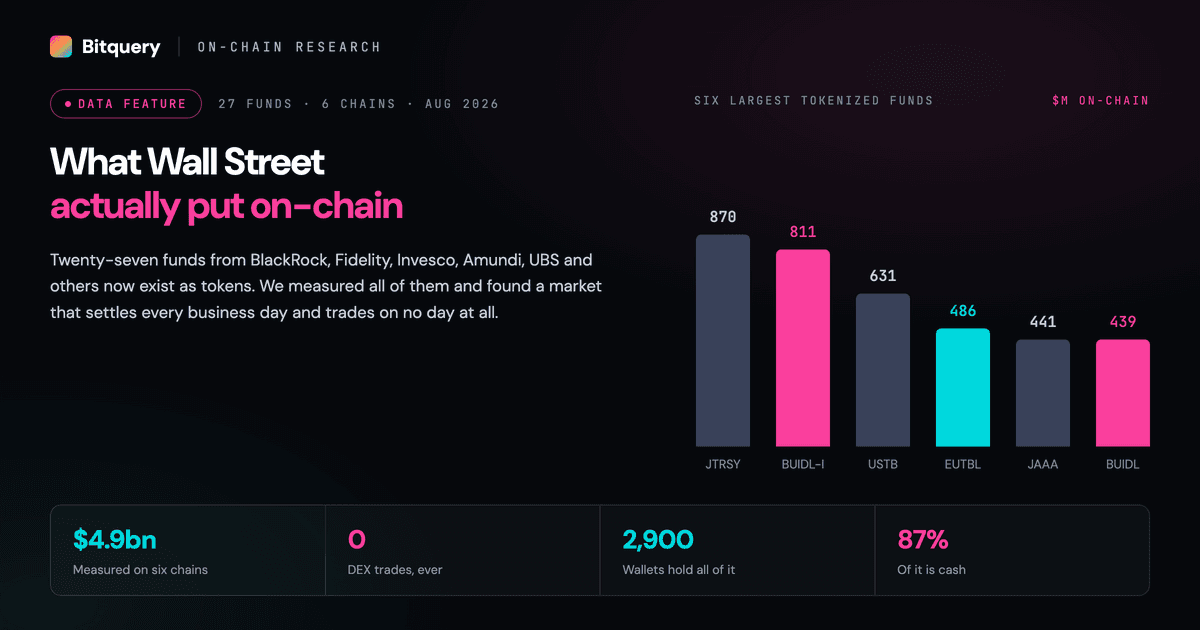
Twenty-seven funds from BlackRock, Fidelity, Invesco, Franklin Templeton, Amundi, UBS and others now exist as tokens on public blockchains. We measured every one of them across six chains, then went looking for who owns them.
Every business day at about the same time, BlackRock's fund on Ethereum does one thing. It creates 33 tiny amounts of itself and sends one to each of its holders. Then it stops. On Saturday and Sunday nothing happens at all.
That is the fund working exactly as designed, and those 33 payments are interest. Over 31 days they made up around 96% of everything that happened to the fund on Ethereum, where it holds about $280 million.
Two ideas in that paragraph get used loosely, so it is worth pinning them down.
A money market fund is the dullest product in finance and one of the most useful. You give it cash, it buys very short-term government debt, and it pays you the interest. Its price is designed never to move, so a share is worth $1 today and $1 next year. Companies park spare cash in them because a bank account pays less.
Tokenizing one moves the share register onto a blockchain. Rather than the fund's record keeper holding a list of who owns what, each holding sits as a token in a wallet. The fund is the same fund. The bookkeeping is what changed.
Bitquery indexes transfers across more than 40 chains, so we went looking for all of it. We swept a registry of 18,716 tokens for the names of roughly four dozen large financial institutions, checked every candidate against the chain itself, threw out the impersonators, and measured what survived: supply, holders and every movement, on Ethereum, Polygon, BNB Chain, Arbitrum, Optimism and Base.
What came back is smaller and stranger than the press releases suggest. The industry's whole on-chain output comes to $4.9 billion, of which the incumbent managers' own funds are $3.9 billion. Not one of those funds has ever traded. And the entire thing is held by roughly 2,900 wallet addresses.
What they actually tokenized
Four kinds of thing, and one of them barely counts.
| What it is | Money on-chain | Funds | Share | In plain words |
|---|---|---|---|---|
| Money market and treasury funds | $4,243m | 17 | 87% | Parked cash earning government interest |
| Credit and CLO funds | $558m | 5 | 11% | Bundles of loans to companies |
| Private credit funds | $51m | 3 | 1% | Direct lending, normally locked up for years |
| Crypto basis funds | $33m | 2 | 1% | A hedged crypto trade, run by a fund |
Cash is 87% of it. Most of the rest is lending in two flavours. For the wider picture, including the gold, currency and property tokens issued by everyone else, see our census of eleven kinds of tokenized asset.
Then there is what nobody tokenized. Among the 27 funds, none holds shares. No tokenized S&P 500 fund from a fund manager, no tokenized Nasdaq tracker from the firm that runs the actual Nasdaq tracker. That matters because tokenized stocks are the loudest part of this market. You can buy a token called QQQ, or NVDA, or SPY on several exchanges today, and we have already measured how thin those markets are. Every one of them is the work of a crypto exchange or a crypto startup wrapping a share it bought. The asset manager whose name is on the product had no part in it, and in several cases has never publicly commented on it.
So a traditional firm putting something on a blockchain reaches for the boring end of its own shelf.
How one of these actually works
BlackRock's is the one people have heard of. It is called BUIDL, and the mechanics repeat across most of the group.
- You prove who you are. Securitize, the fund's transfer agent, runs the checks and adds your wallet to an approved list. A wallet that is not on the list cannot receive the fund at all.
- You wire dollars in. The minimum is $5 million, and you have to be what US rules call a qualified purchaser, which broadly means an individual with $5 million invested or an institution with $25 million.
- Tokens appear in your wallet. That is your shareholding.
- Every business day the fund pays you interest by creating new tokens and sending them to you. Those are the 33 daily payments.
- To leave, you send the tokens back, they are destroyed, and dollars are wired out.
Step 4 can be checked rather than taken on trust, using a plain token transfer query. On 20 August the fund paid 19,578 units, split across 31 wallets that held 199.1 million units between them. Annualised, that is 3.59%, which is about what short-dated US government debt was paying. The payments are interest, and the arithmetic says so.
Two consequences follow. The blockchain here is doing the job of a share register rather than the job of a market. And because of that approved-list step, a token can never move somewhere its issuer has not already agreed to send it, which explains almost everything that comes next.
Every fund we found
Sizes below are what we measured ourselves across the six chains, valued at each fund's own share price. The holdings column counts positions, so a wallet holding the same fund on three chains appears three times.
| Fund | Sponsor | What it holds | On-chain | Holdings | Chains |
|---|---|---|---|---|---|
| JTRSY | Janus Henderson | Short-term US government bills | $870.5m | 16 | Ethereum |
| BUIDL-I | BlackRock | US Treasuries, cash and repo | $811.0m | 5 | Ethereum |
| USTB | Invesco | Short-dated US government debt | $630.6m | 81 | Ethereum |
| EUTBL | Spiko | Eurozone government bills | $485.5m | 1,630 | Ethereum, Polygon, Arbitrum, Base |
| JAAA | Janus Henderson | Top-rated slices of bundled company loans | $440.8m | 23 | Ethereum, BNB, Base |
| BUIDL | BlackRock | US Treasuries, cash and repo | $439.4m | 85 | Ethereum, Polygon, BNB, Optimism, Arbitrum |
| eurSAFO | Amundi | Overnight euro money market | $234.0m | 813 | Ethereum, Polygon, Arbitrum, Base |
| WTGXX | WisdomTree | US government money market | $216.2m | 76 | Ethereum, Arbitrum, Base |
| BENJI | Franklin Templeton | US government securities | $187.6m | 18 | Ethereum, Polygon, Arbitrum, Base |
| USTBL | Spiko | US treasury bills | $163.2m | 667 | Ethereum, Polygon, Arbitrum, Base |
| STAC | Securitize | Top-rated slices of bundled company loans | $103.2m | 4 | Ethereum |
| FDIT | Fidelity | Dollar interest-bearing fund token | $51.1m | 2 | Ethereum |
| BRSRV | BlackRock | Stablecoin reserves, reinvested daily | $50.1m | 1 | Ethereum |
| ACRED | Apollo | Feeder into Apollo private lending | $46.2m | 34 | Ethereum, Polygon |
| VBILL | VanEck | Short-term US Treasuries | $43.2m | 17 | Ethereum, BNB |
| FILQ-A | Fidelity | Dollar liquidity fund | $35.6m | 3 | Ethereum |
| eurSPKCC | Spiko | Crypto basis trade, euro hedged | $22.2m | 32 | Ethereum, Polygon, Arbitrum, Base |
| uMINT | UBS | US dollar money market | $20.3m | 30 | Ethereum |
| SPKCC | Spiko | Crypto basis trade | $10.7m | 14 | Ethereum, Polygon, Arbitrum |
| deJAAA | Janus Henderson | JAAA repackaged for crypto markets | $8.1m | 187 | Ethereum, Arbitrum, Base |
| HYBOND | BNY Mellon | Short-dated high-yield company bonds | $4.5m | 7 | Ethereum, BNB |
| HLSCOPE | Hamilton Lane | Senior private loans | $4.3m | 40 | Ethereum, Polygon |
| UKTBL | Spiko | UK treasury bills | $2.9m | 80 | Ethereum, Polygon, Arbitrum, Base |
| HINC | Neuberger Berman | High-income company credit | $1.3m | 1 | Ethereum |
| gbpSAFO | Amundi | Overnight sterling money market | $1.2m | 39 | Ethereum, Polygon, Arbitrum, Base |
| FILQ-D | Fidelity | Dollar liquidity fund | $0.3m | 2 | Ethereum |
| ACRDX | Apollo | Second route into Apollo private lending | $0.2m | 3 | Ethereum |
Several of those rows need a word. JTRSY is the largest thing here, and 98% of it sits at a single address whose behaviour looks like a custodian or a pooling vehicle rather than an end investor. Whose it is, we cannot tell you. BUIDL and BUIDL I-Class are two share classes of the same BlackRock fund, sold to different investors. JAAA and deJAAA are the same Janus Henderson loan fund, the second repackaged so it can be used inside crypto applications. ACRED and ACRDX are likewise two doors into one Apollo credit fund. SPKCC and eurSPKCC are the odd ones out, not cash funds at all but a hedged crypto trade wrapped in a regulated fund. BRSRV is barely three weeks old.
Four more that exist, and none we can count
Leaving these out silently would make the picture tidier than it is.
- FIUSD is listed publicly as a Sygnum fund. On-chain the token is named Fidelity ILF USD Fund Class G Acc, which makes it a Fidelity fund that Sygnum tokenises, worth about $48 million. It lives on zkSync, which is outside the six chains measured here, and its Arbitrum contract is empty. Fidelity therefore has four on-chain products rather than the three in the table.
- JPMorgan's My OnChain Net Yield Fund and its OnChain Liquidity-Token Money Market Fund are listed with no contract address on any public chain.
- BlackRock's Select Treasury Based Liquidity Fund is in the same position.
- A Swiss franc share class of the Amundi fund has a live Ethereum contract that has never recorded a single transfer.
Nobody trades them
We checked every one of these funds against every decentralised exchange we index on all six chains, using the same token trade data that powers our DEX products. Across the entire lifetime of every contract, the number of trades is zero. To be sure the question itself was not broken, we ran the identical query against USDC, the largest dollar token on Ethereum, and it returned 78 million trades.
There is one exception, and it is the instructive one. Janus Henderson built a version of its loan fund specifically to be usable in crypto markets, on Base. It managed 2,083 trades and 250 buyers in its first year, and in the last month it managed none. The one product designed to trade has stopped trading.
Ordinary movement is just as flat. Across every institutional fund on Ethereum over 31 days there were 4,421 transfers, sent by 178 addresses in total. USDC on the same chain over the same days ran to 19.4 million transfers from 2 million senders. At the rate USDC moves, a month of Wall Street's on-chain fund activity would be over in about ten minutes.
Almost nobody owns them
| Money on-chain | Wallet addresses | |
|---|---|---|
| Incumbent managers and banks, own funds | $3.86bn | 581 |
| Spiko, a French fintech, and the Amundi funds it runs | $1.02bn | 2,367 |
The 19 funds run by the big incumbents are held by 581 addresses, a figure anyone can rebuild with a token holder query. Across the five largest of them we checked every holding address, and a quarter turned out to be smart contracts doing custody or pooling for somebody else rather than wallets a person logs into. BlackRock's institutional share class, holding $811 million, sits in five wallets. Fidelity's Digital Interest Token has two. A new BlackRock cash vehicle has one, and so does Neuberger Berman's fund.
The second row is the strange one. Spiko, a company most people in finance have never heard of, holds four in every five wallets on this entire board while managing a fifth of the money.
The reason is not technology. It is the minimum ticket. BlackRock asks for $5 million and qualified-purchaser status. Invesco's fund asks for $100,000. Spiko's euro fund is a French regulated fund open to ordinary savers and asks for €1,000. Change the minimum and you change who turns up.
So the money here is institutional and the customer list is very short. A normal person appears in this data in only one place, which is where a small European firm decided to let them in.
Two of the biggest were bought, not built
Invesco's tokenized treasury fund, fifth largest here at around $630 million on Ethereum, was built by Superstate, a crypto firm founded by Robert Leshner, who also created the lending protocol Compound. In March 2026 Invesco took over as investment manager and the fund was renamed. It kept the same ticker, the same smart contracts and the same token address, and on the blockchain the token still carries Superstate's name today.
The same pattern sits at the top of the table. Janus Henderson's treasury fund, the largest single holding we measured, begins its on-chain life in August 2024 as the Anemoy Liquid Treasury Fund, a product of the crypto platform Centrifuge. The Janus Henderson ticker appears in our data from May 2025.
Neither firm deployed a contract. Each acquired one that was already running, which is a faster route onto a blockchain than building, and a quieter one.
Who is still missing
Of the large asset managers people ask about most, Vanguard, Goldman Sachs and Charles Schwab have no fund we can find on any public chain we index. Vanguard in particular has been openly cool on crypto for years.
Their names sit on-chain anyway, attached to tokens they did not issue. One of them is a "Vanguard Oil Retirement Fund", a product Vanguard has never offered. We will tell that story separately.
JPMorgan needs stating carefully. It has two on-chain money funds listed publicly, but neither carries a contract address on any chain we index, so we have not counted them. The accurate version is that JPMorgan has nothing we can see.
Check our work
Every figure above came from public blockchain records, and the same rows are there for anyone to pull. These fund contracts are ordinary tokens. BlackRock's is at 0x7712c342... on Ethereum, Franklin Templeton's at 0x3ddc8494..., Invesco's at 0x43415eb6.... Paste any of them into Bitquery Explorer and the daily interest payments are visible arriving. Holdings can be rebuilt with the token balance API, and anyone who would rather watch the transfers land as they happen can take the same data through Kafka streams.
Some caveats we would rather state than bury. We measured six chains, and several of these funds also live on Aptos, Avalanche, Stellar, Solana, zkSync and others we did not measure here, so $4.9 billion is a floor rather than a total. Where a fund also publishes an all-chain figure, we cover about 46% of it. Holder counts are wallet addresses rather than people, and one investor can hold on several chains at once.
None of that changes the shape of it. The world's largest asset managers have put a real and verifiable amount of money onto public blockchains, they have put it there as cash, and they have done it for a few hundred customers who each hold millions of dollars. What runs on the blockchain is the share register. Whether that was the point of blockchains is a different question, and a fair one.
Analyze these funds yourself
The register these funds keep is public, and reading it does not require writing a query. Point Bitquery MCP at any contract in the table above, over the same real-world asset data behind every figure here, and ask what you would ask an analyst: who holds this fund, how much sits with its largest holder, when it last paid interest, whether anyone has ever traded it.
Ask a tokenized fund what it did today
The 27 funds above are ordinary tokens on chains we index. Give the MCP server a contract address and ask in plain English for its holders, its supply history, its daily issuance or its trades. The queries behind these numbers are the same ones, and none of them needed private data.
Start with any of the three Ethereum contracts listed above. Ask one of them for its holder list and the entire shareholder register comes back in a single answer, which is the part that still surprises people.
FAQ
What is a tokenized money market fund?
A money market fund whose share register is recorded on a blockchain. The fund still holds short-term government debt and still pays interest. Ownership is tracked as tokens in wallets rather than as entries in a transfer agent's database.
How big is BlackRock's BUIDL fund?
We measure $439.4 million across five of the six chains we index, on Ethereum, Polygon, BNB Chain, Optimism and Arbitrum, plus $811.0 million in a separate institutional share class on Ethereum. BUIDL also exists on chains outside those six, so the true total is higher.
Can anyone buy these tokenized funds?
Mostly no. BlackRock's fund requires $5 million and qualified-purchaser status, and Invesco's requires $100,000. The exception is Spiko's European funds, which are regulated retail funds with a €1,000 minimum.
Can you trade tokenized funds on a DEX?
Not these ones. Across all six chains, none of the 27 funds has ever recorded a decentralised exchange trade, because holders must be on an issuer-approved list before a token can reach them.
Which asset managers have tokenized funds on-chain?
BlackRock, Fidelity, Invesco, Franklin Templeton, Janus Henderson, Amundi, UBS, VanEck, WisdomTree, Apollo, Hamilton Lane, Neuberger Berman and BNY Mellon, alongside the fintech issuers Spiko and Securitize. Vanguard, Goldman Sachs and Charles Schwab have none we can find.
Subscribe to our newsletter
Subscribe and never miss any updates related to our APIs, new developments & latest news etc. Our newsletter is sent once a week on Monday.