Bitcoin Analysis: Track Transactions and Addresses
A step-by-step way to follow a Bitcoin payment: find the real recipient, open the money flow graph, then go deeper hop by hop or ask an AI to do it.
A standard block explorer shows one payment at a time. To follow coins with it you open a payment, copy the next address into a spreadsheet, open that one, and repeat. It is slow, it has no labels, and one missed payment breaks the trail.
There are two faster ways. The Bitquery explorer draws the flows around a wallet as a graph, and it needs no account. Or you can hand the wallet to an AI and ask where the money went. The example is one real payment from February 2021. We tested each step again on 2 October 2026.
Step 1: find the real recipient
Start with this payment. Call the sender Alice and the recipient Bob.
Bitcoin payments work like cash. You hand over a note that is worth more than the price, and you get change back. So a payment has inputs, which are the notes, and outputs, which are the payment and the change.
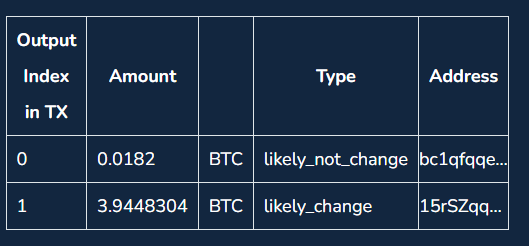
| Part of the payment | Amount | Tag on the explorer |
|---|---|---|
| Input, from Alice | 3.96 BTC | |
| Output 0 | 0.0182 BTC | likely_not_change |
| Output 1 | 3.94 BTC | likely_change |
Scroll down the page to the outputs. The explorer tags each one with its best guess. The small output is tagged likely_not_change, so that address is Bob. The large one is most likely Alice's change.
Step 2: open the money flow graph
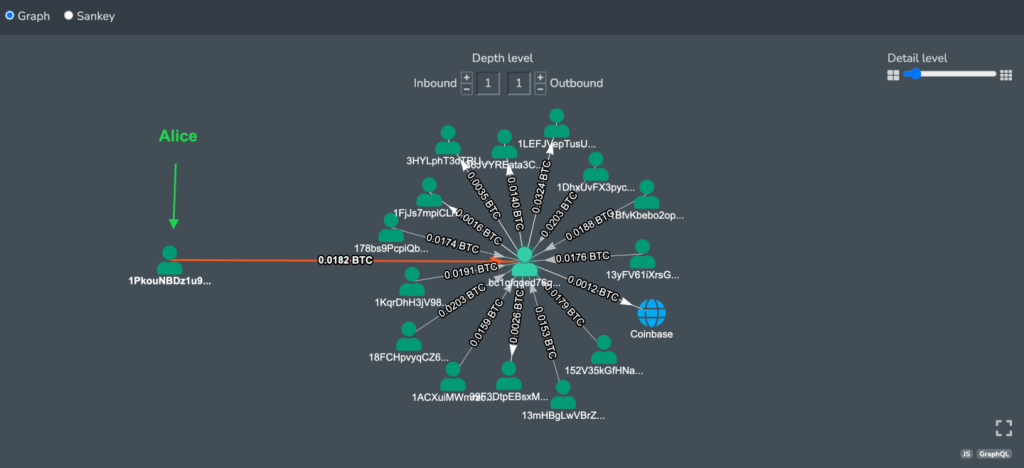
Open Bob's address and pick the Money Flow tab.
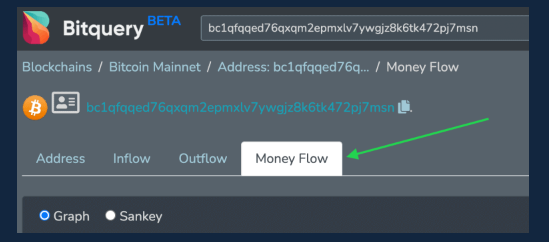
One thing trips people up here. The page shows the last seven days by default, so an old payment will not appear until you widen the date range. For this example, set it to cover February 2021, or open the graph with the range already set. The graph can take half a minute to draw.
The graph shows every wallet that paid Bob or was paid by Bob, one hop away. Alice is among them.
Step 3: go deeper
One hop is a direct payment from one address to another. Two hops means one wallet sits in between, and so on.
The Depth level control sets how many hops the graph draws. You can raise it in two directions. Inbound follows the money back to where it came from. Outbound follows it forward to where it went. Raise the inbound depth and you see who paid Alice before she paid Bob.
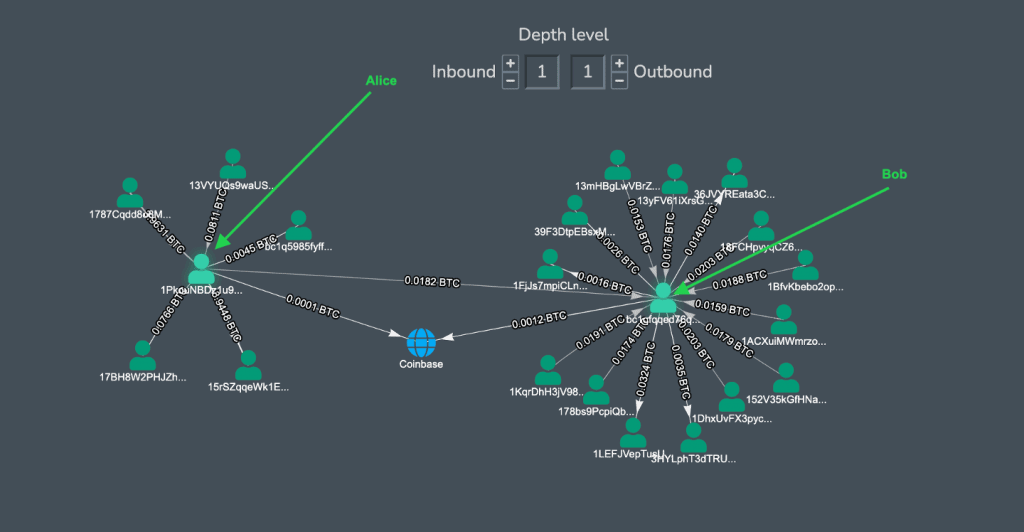
Each graph has a Get API button. It opens the query behind the picture, so a developer can pull the same data into another tool. The Bitcoin Coinpath docs explain the query.
The Sankey view
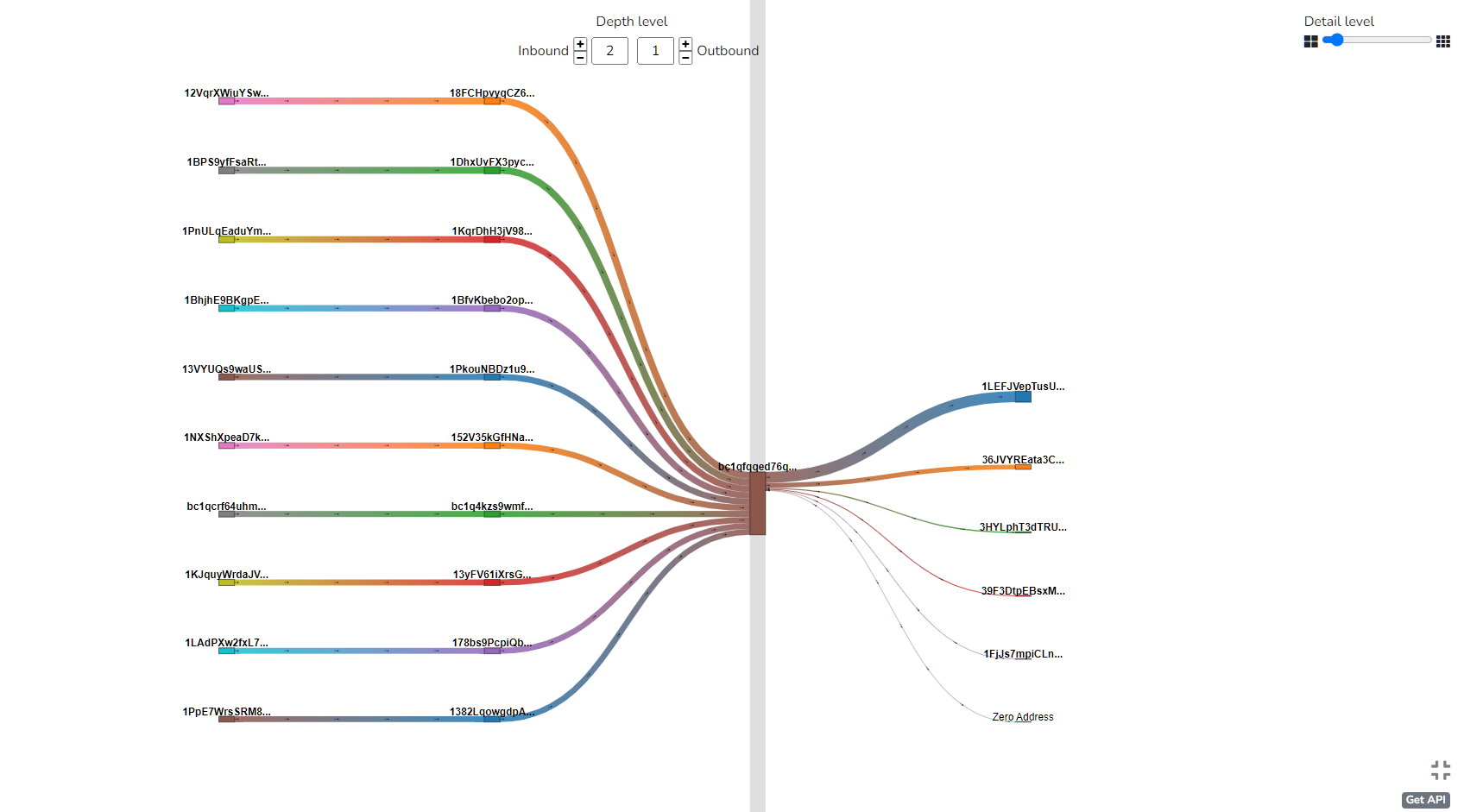
The same page has a second view. Pick the Sankey button and the flows are drawn as bands, with money coming in on one side and going out on the other. The width of each band matches the amount, so the large flows stand out at once.
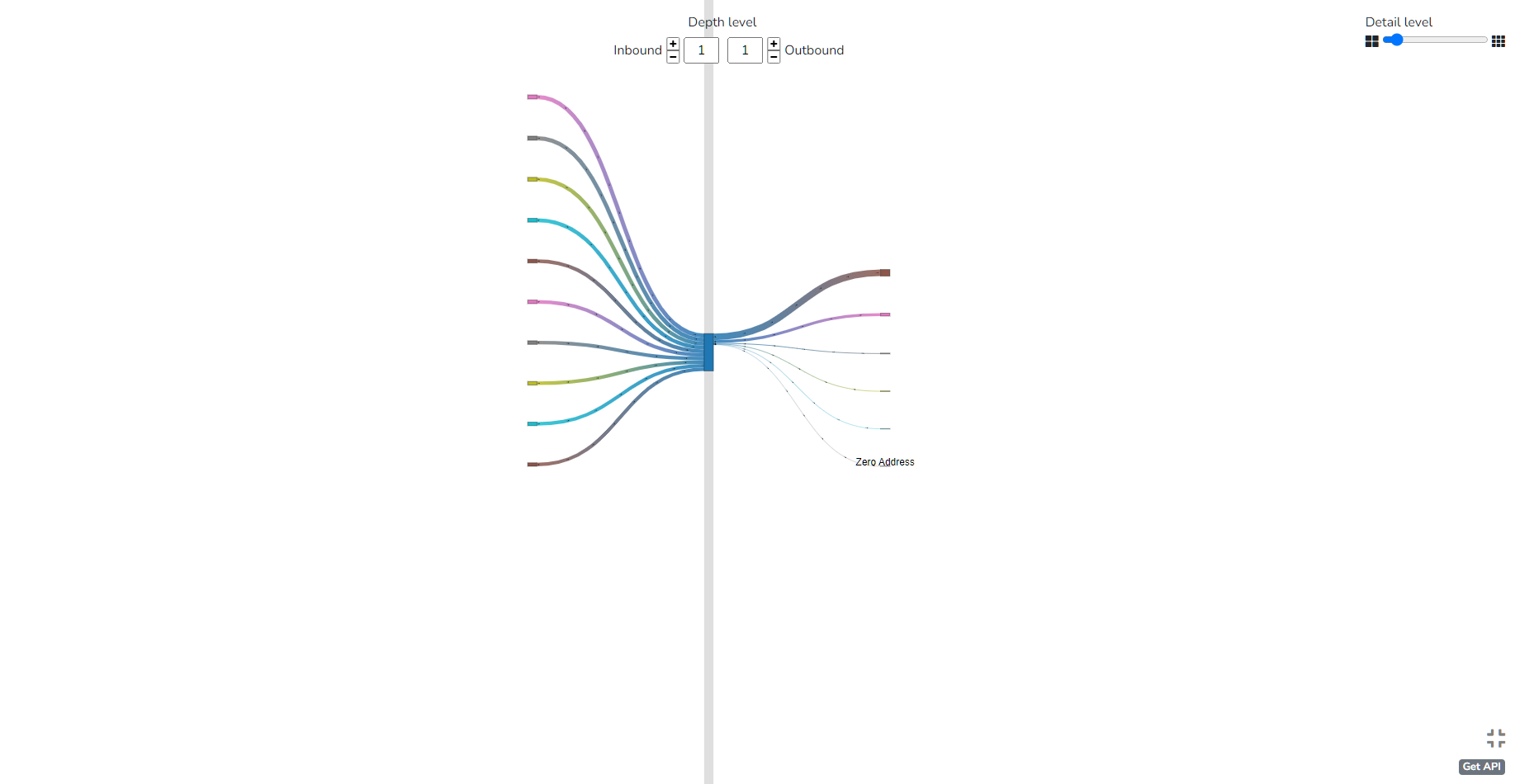
Raise the depth here too and the picture stretches from the first source to the last address reached.
Or ask an AI to trace it
The graph is good for a first look. For a long trail, the Bitquery MCP server is quicker. You connect it to Claude, ChatGPT or Cursor and ask in plain English.
Trace the money by asking an AI
Connect the Bitquery MCP server to Claude, Cursor or ChatGPT and ask in plain English where funds from an address went. The agent follows each hop, names the exchanges and mixers on the path, and returns the transactions behind every step.
Prompts to try with Bob's address:
- "Where did the funds from this address go? Stop at the first exchange."
- "Which other addresses were spent together with this one?"
- "Is this an exchange deposit address, a mixer or a known scam?"
Tracing sits on the AI Investigation plan at $149 per month, and a trial comes with 100 free credits. The install guide covers each client.
Where to go next
- Tracing Bitcoin transactions and addresses explains why tracing works and what gets in the way.
- How to investigate an Ethereum address covers the same job on Ethereum.
- If your own coins were stolen, see the crypto investigation service.
First published in February 2021. Updated on 2 October 2026 by the Bitquery team: each step was tested again on the live explorer, and AI tools helped with the testing and the redraft. Bitquery sells the MCP server, the Coinpath API and the investigation service named above.
Subscribe to our newsletter
Subscribe and never miss any updates related to our APIs, new developments & latest news etc. Our newsletter is sent once a week on Monday.